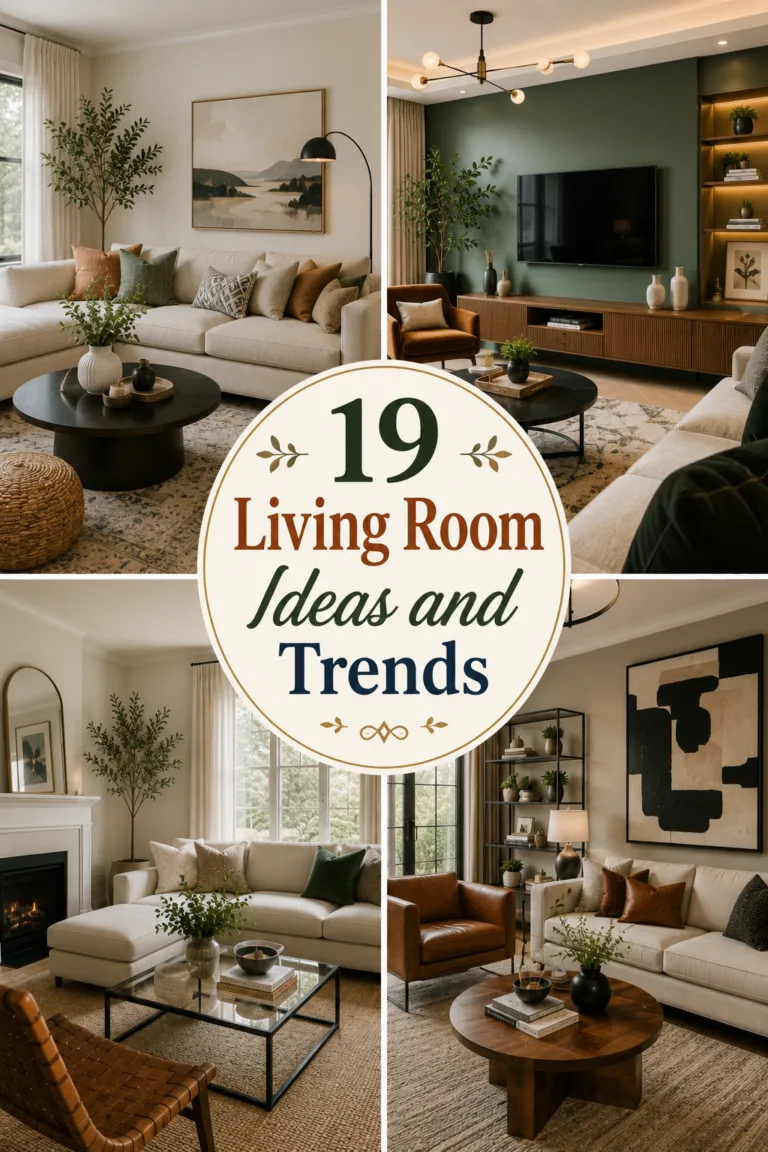
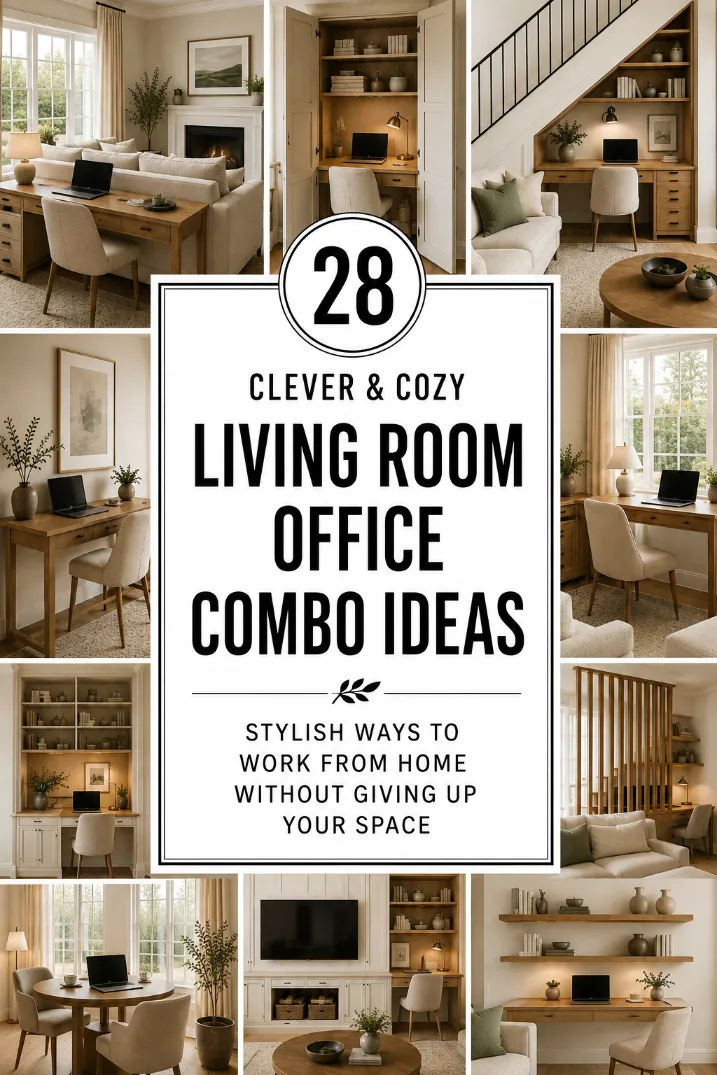
Living room office combo ideas have become one of those things I keep coming back to because not everyone has a spare room just waiting to become a home office.
And honestly, I don’t think you need one.
A living room can work perfectly well as both a comfortable place to relax and a practical place to work. The trick is making the office part feel intentional instead of looking like someone simply dropped a desk beside the sofa.
That is always my goal with a shared room.
I want the desk to work when I need it, but I don’t want it to control the whole living room.
For me, the best setups use things like slim desks, hidden storage, built-ins, console tables, cabinets, shelves, folding workstations, and furniture that can quietly do two jobs.
If you are trying to squeeze a workspace into a small apartment, family living room, or open-plan home, these are the 28 living room office combo ideas I would actually consider.
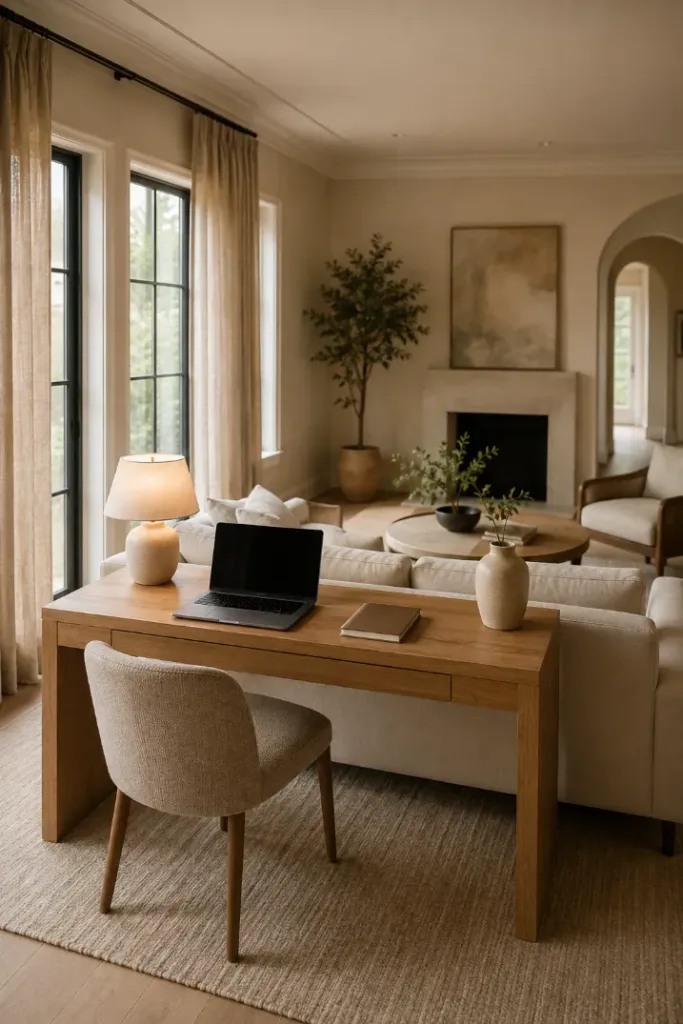
1. Put a Slim Desk Behind the Sofa
This is one of my favorite layouts because the desk almost disappears.
If your sofa floats in the middle of the room, place a narrow desk or console-style table directly behind it.
The back of the sofa naturally separates the work zone from the seating area.
I would keep the desk fairly shallow.
You only need enough room for a laptop, lamp, notebook, and maybe a small drawer.
Once the chair is tucked underneath, it can look almost like a normal console table.
This works especially well in open-plan living rooms.
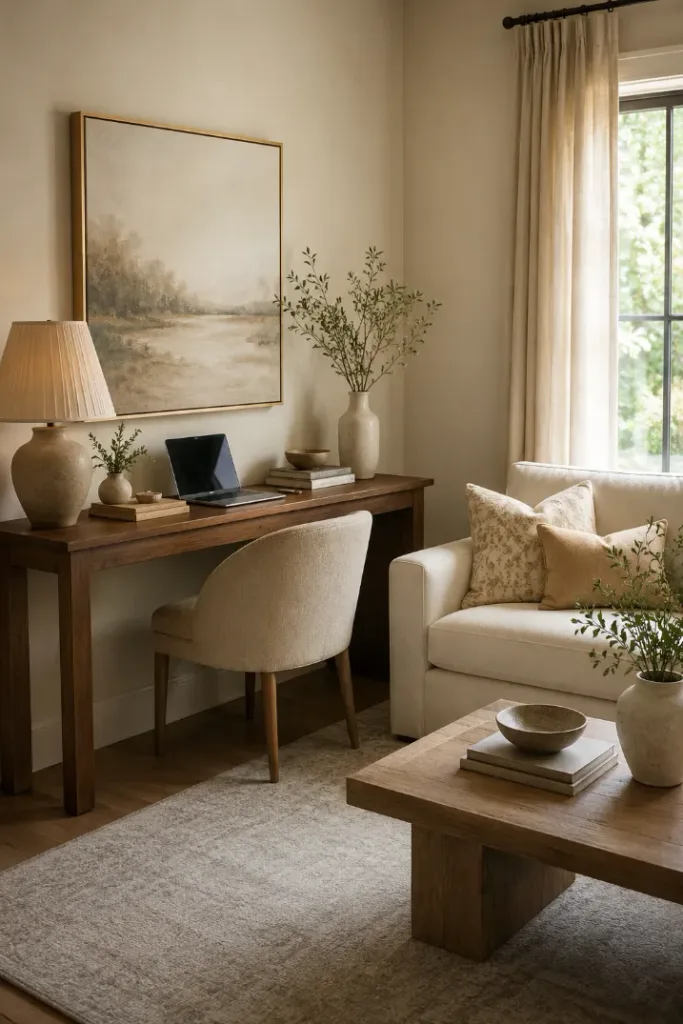
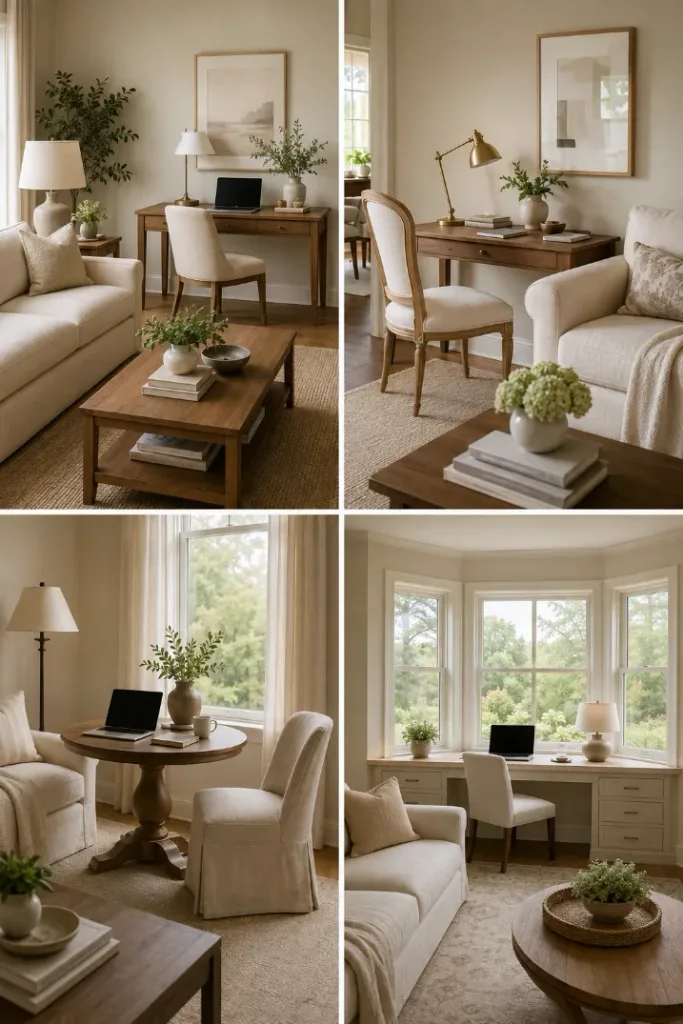
2. Use a Console Table as a Desk
You may already have something in your living room that can become a workspace.
A console table is a good example.
Choose one that is deep enough for a laptop and comfortable enough to sit at.
Then add a proper chair instead of a decorative stool.
During the day, it is your desk.
When work is finished, close the laptop and style the table with a lamp, books, or vase.
I really like furniture that can quietly change jobs like this.
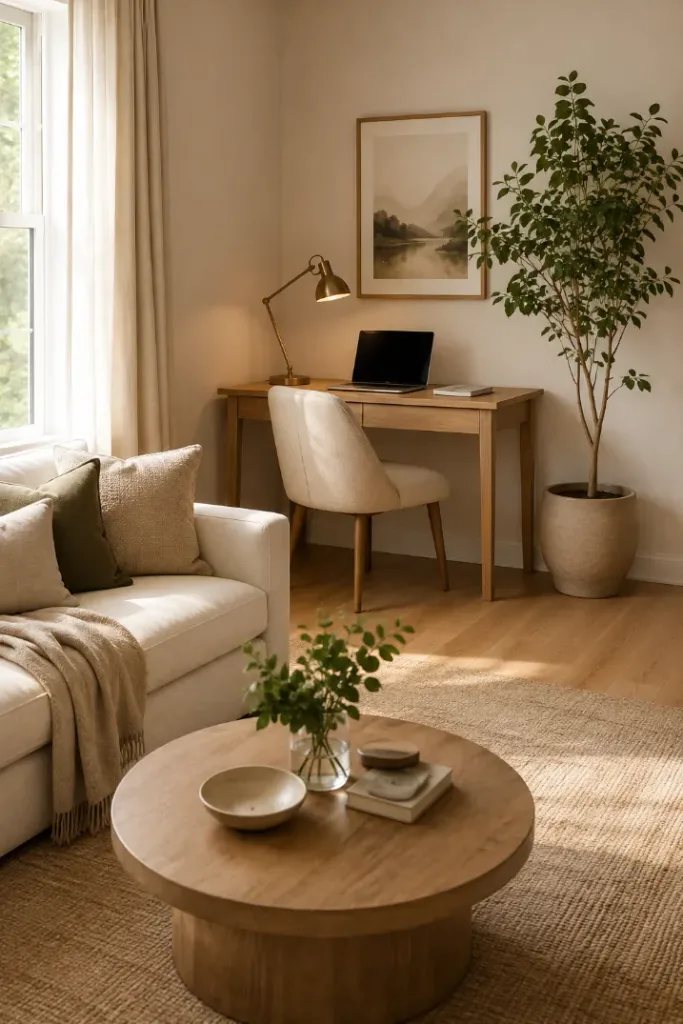
3. Tuck the Desk Into an Empty Corner
Living room corners are often wasted.
A compact desk can fit into one without taking over the room.
I would keep the desk simple and choose a chair that works with the rest of the living room furniture.
That matters.
If you use a big black office chair in a soft cream living room, the workspace immediately stands out.
A wood-frame upholstered chair or slim neutral desk chair blends in much better.
Add one lamp and a small piece of art above the desk and it can feel like part of the room.
4. Put the Desk Beside a Window
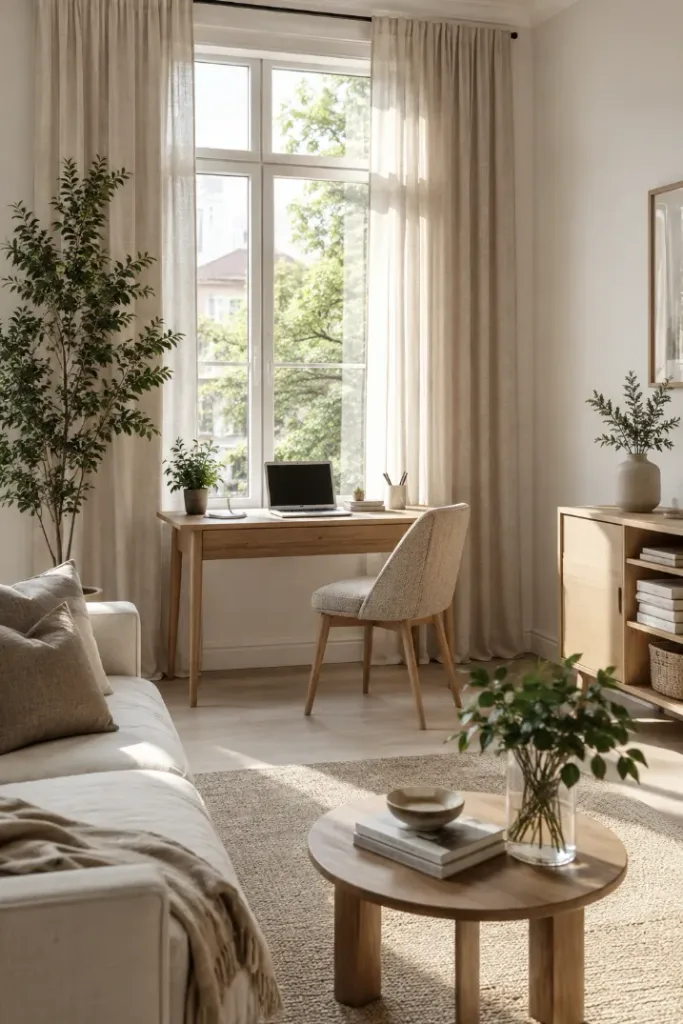
If I had a choice, I would always try to put the workspace near natural light.
A small desk beside a window can feel much less cramped.
You also get something nicer to look at than a blank wall.
I would avoid blocking too much of the window, though.
Choose a slim desk and keep tall storage somewhere else.
Floor-length curtains can still frame the area and make the workspace feel softer.
This setup is especially nice for small living rooms.
5. Use the Space Between Two Windows
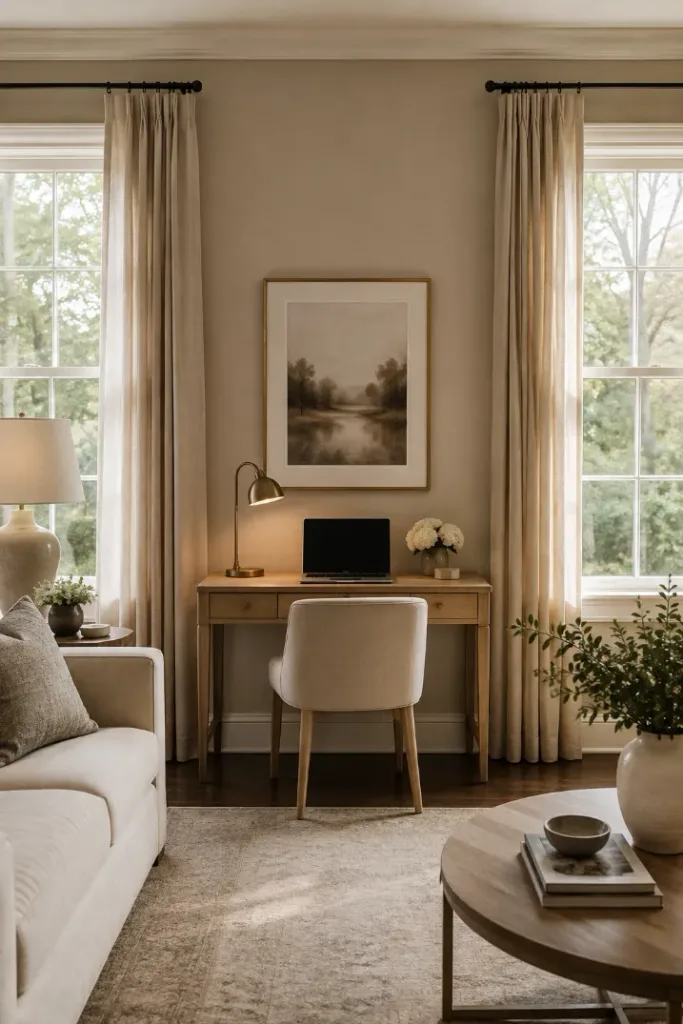
This can be a really good place for a desk.
A narrow wall between windows often does not have another obvious use.
Place a slim desk there and let the windows provide light from both sides.
I like this even more when the desk is wood and the chair matches the living room.
It starts to feel like a piece of furniture rather than a separate office zone.
A small framed artwork or wall light above the desk can finish it without making the wall busy.
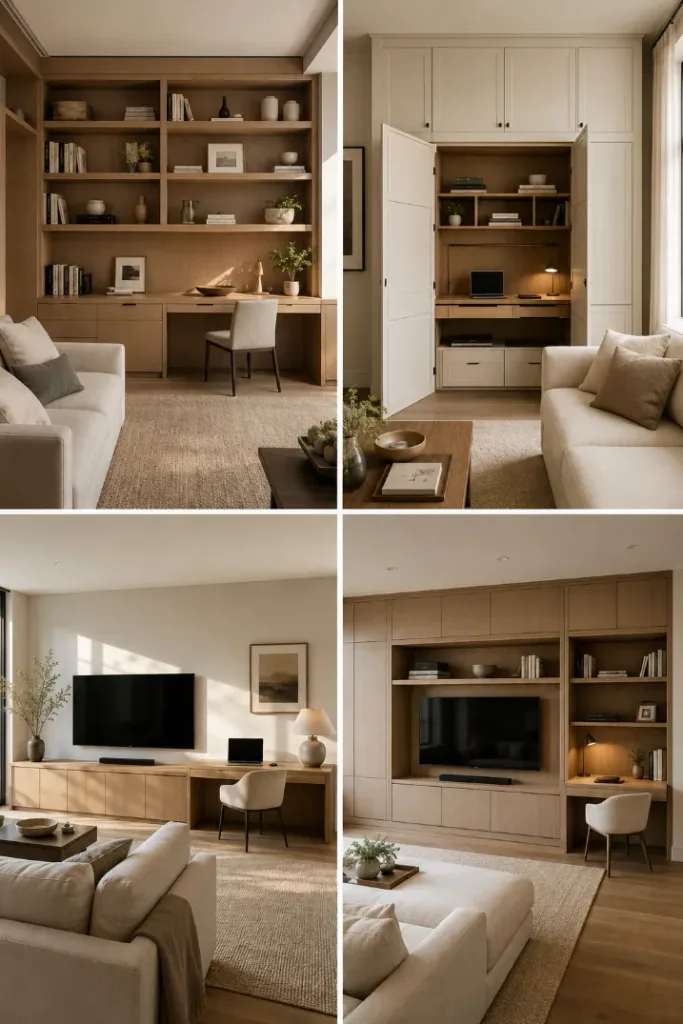
6. Build the Desk Into Bookshelves
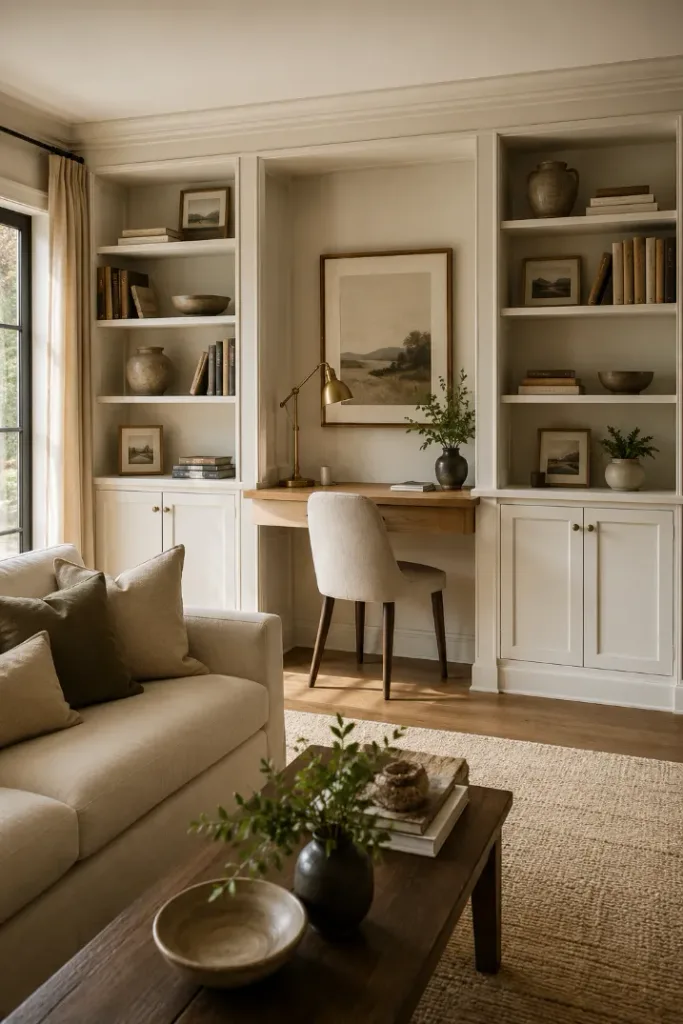
If you already have built-ins, this is probably one of the cleanest solutions.
Leave a wider opening between the shelves and use it as a desk.
The shelves can hold books, office supplies, artwork, and living room decor at the same time.
I would keep the desk top the same material or color as the shelving.
That makes the whole thing look planned.
Closed cabinets underneath are even better because you can hide printers, cables, paperwork, and all the less attractive office stuff.
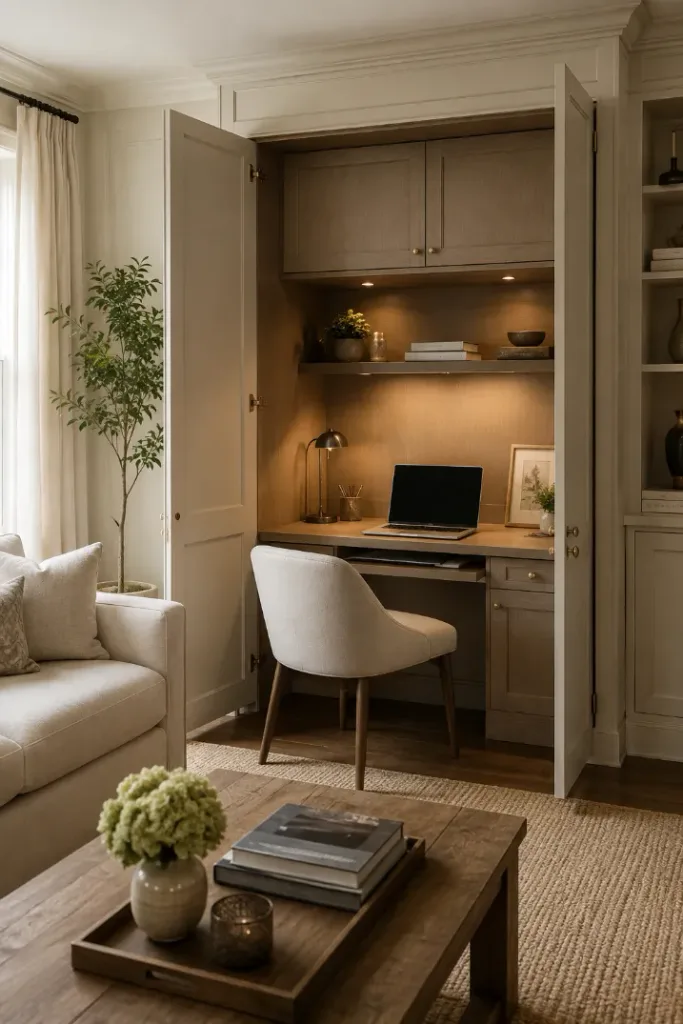
7. Add a Desk Inside a Built-In Cabinet
This is one of the best ways to hide an office.
Use a tall cabinet or built-in with doors.
Inside, add a work surface, shelves, light, and maybe a charging outlet.
Open the doors when you are working.
Close them when you are done.
Then your living room looks like a normal living room again.
For me, this is especially useful if you hate seeing work when you are trying to relax.
Once those doors close, the office is mentally gone too.
8. Try a Secretary Desk
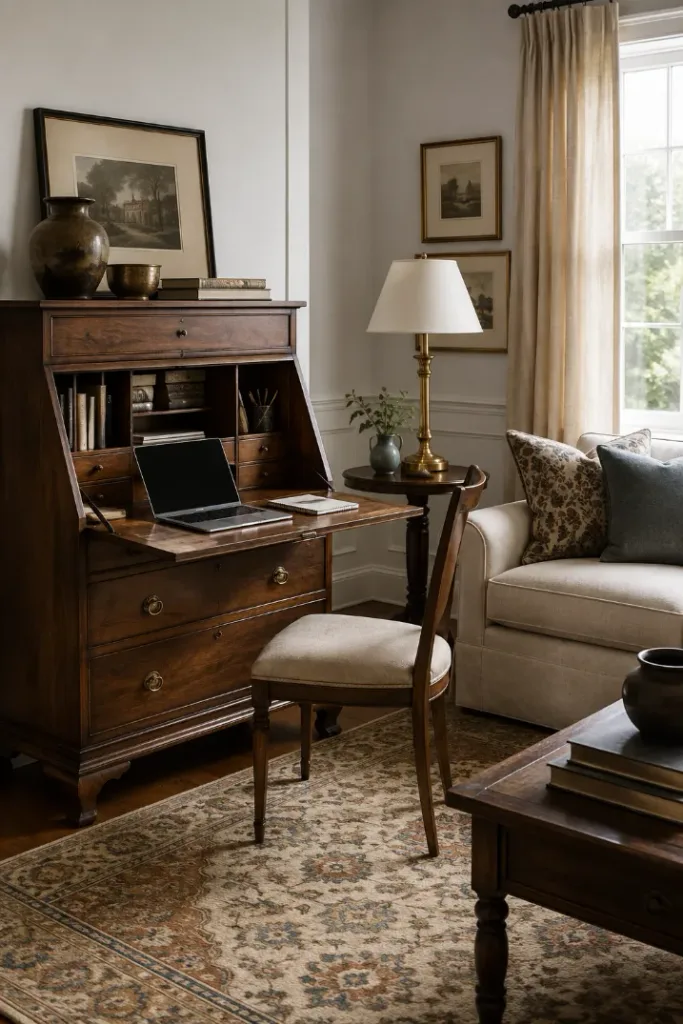
A secretary desk is one of those older furniture pieces that suddenly makes so much sense again.
The front folds down to become a work surface.
Inside, you get small shelves or compartments.
Then everything closes back up.
I like this because it adds character instead of looking like standard office furniture.
A dark wood secretary desk can look beautiful in a traditional room.
A lighter simple version can work in a modern space.
It is practical and decorative at the same time.
9. Use a Wall-Mounted Fold-Down Desk
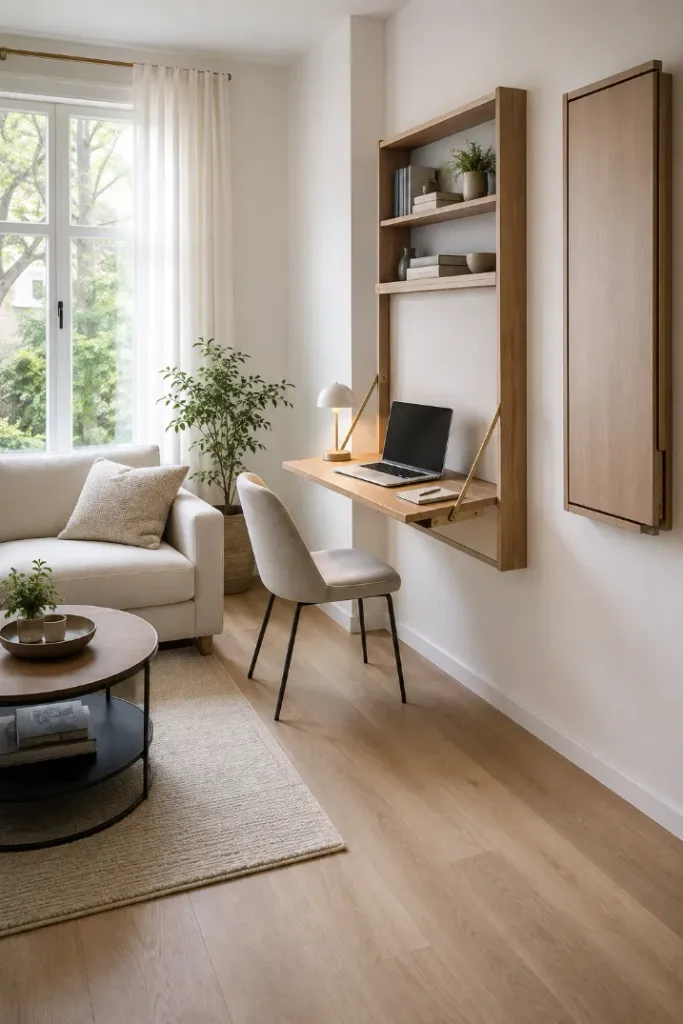
If floor space is really tight, I would look at the wall.
A fold-down desk takes up almost no room when it is closed.
Open it when you need to work.
Fold it back up afterward.
Some designs also include small shelves for notebooks and stationery.
I would use this in a tiny living room, studio apartment, or rental where you do not want another full furniture piece.
Keep the chair lightweight so it can move somewhere else when the desk is closed.
10. Use a Floating Desk
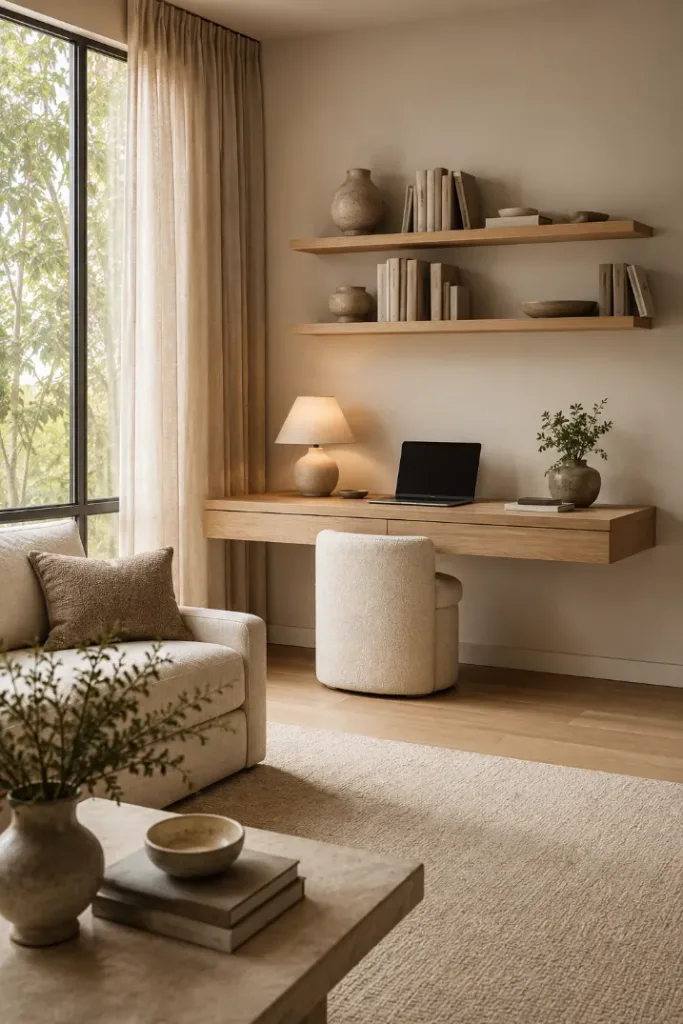
A floating desk can make the room feel much lighter.
It does not need legs, so you see more floor underneath.
That helps a lot in small living rooms.
You can install one along an empty wall and add a slim chair underneath.
I would keep the desktop fairly shallow and use wall shelves above if you need extra storage.
This works beautifully in modern and minimalist rooms.
11. Extend Built-In Shelves Into a Desk
Sometimes you do not need to build a whole office.
You can simply extend one shelf.
Imagine open shelving running along the wall and one section dropping slightly lower to desk height.
That lower surface becomes the workstation.
Everything still feels connected.
I like this approach because the office does not look added afterward.
It feels like part of the architecture.
12. Hide the Desk Behind Cabinet Doors
If you have a wall of storage, dedicate one section to the office.
The doors can look exactly like the rest of the cabinetry.
Inside, you can fit a desk surface, monitor, shelves, and lighting.
Close the doors and no one would know it is there.
This is probably one of my favorite ideas if the living room needs to stay polished.
Especially if you work from home every day but still want the room to feel calm in the evening.
13. Put the Desk Next to the TV Unit
The TV wall can often do more than one job.
If you have a long media unit, extend it into a desk on one side.
Use the same wood or finish.
Then the whole wall feels like one piece of furniture.
I would keep the desk section slightly lower or clearly separate enough to sit comfortably.
This works really well in long, narrow living rooms where you do not have another free wall.
14. Build a Desk Into the Media Wall
This is a more custom version of the same idea.
Imagine closed cabinets along the bottom, TV in the center, shelves around it, and one small desk built into the end.
Everything matches.
Everything has storage.
And the office becomes part of the media wall instead of another thing fighting for space.
If I were designing a small living room from scratch, I would definitely consider this.
15. Use a Desk That Matches the Coffee Table
One simple way to make an office blend into the living room is repeating materials.
If the coffee table is light oak, use a light oak desk.
If the room has walnut furniture, bring walnut into the desk.
That connection makes a big difference.
The desk suddenly looks like it belongs.
You do not have to buy matching furniture.
Just repeat one or two finishes so the room feels connected.
16. Choose a Desk Chair That Looks Like a Dining Chair
This is such an easy trick.
Instead of using a typical office chair, use a comfortable upholstered chair that fits the rest of the room.
Maybe a curved cream chair.
A wood-frame linen chair.
A simple leather chair.
Just make sure it is comfortable enough for how long you actually work.
Then, when the desk is not being used, the chair looks like normal living room furniture.
That alone can make the office feel much less obvious.
17. Use a Small Round Table as a Desk
A small round table can work surprisingly well.
You can use it for working during the day and then treat it like a side table or game table later.
I especially like this in rooms where a rectangular desk would feel too harsh.
A round table also makes movement easier.
You can tuck it near a window or behind the sofa.
Add one comfortable chair and keep the styling simple.
18. Turn a Bay Window Into a Workspace
If your living room has a bay window, you already have a natural little zone.
A shallow desk can fit beautifully inside it.
You get light from several directions.
And because the space is slightly separated from the rest of the room, the office feels like its own area.
I would keep the furniture light so you do not block the window.
A built-in desk can look especially good here.
19. Use the Space Under the Stairs
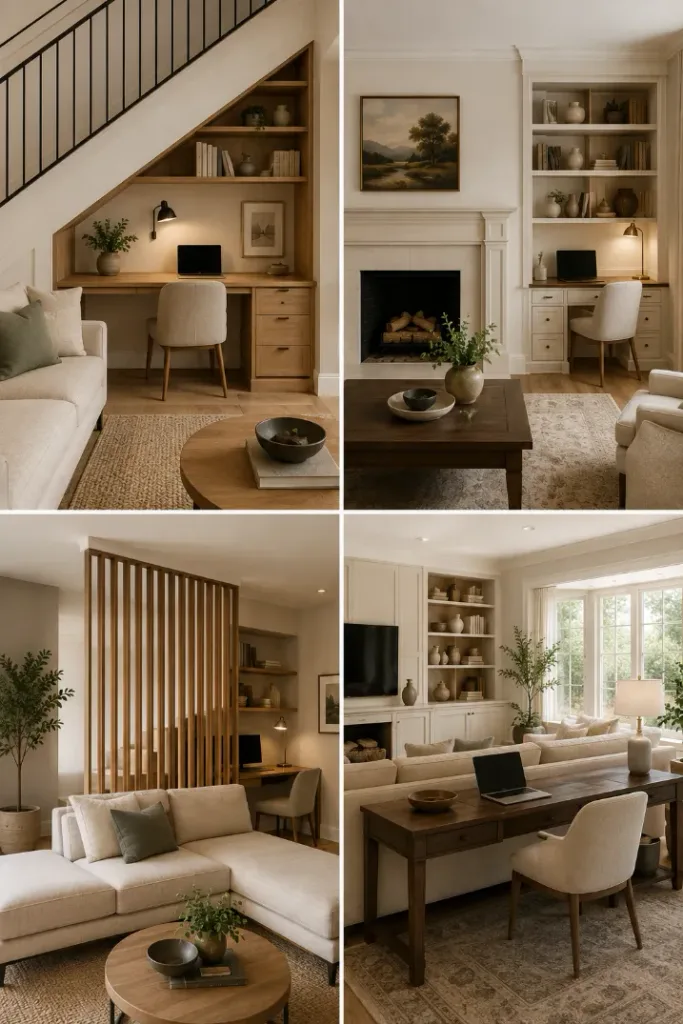
If your living room connects to a staircase, look underneath it.
That awkward space can become a really useful office.
Add a fitted desk, a few shelves, and a wall light.
The sloped ceiling does not matter because you are sitting down anyway.
I like this because it turns an area that often becomes clutter storage into something much more useful.
Closed drawers underneath help keep everything tidy.
20. Add a Desk to One Side of the Fireplace
If you have built-ins or alcoves beside the fireplace, one side can become a workspace.
I would keep the other side as normal shelves or cabinets so the fireplace still stays balanced.
The desk can be built into the alcove with shelving above.
Use the same paint color and trim as the rest of the built-ins.
Then it feels completely intentional.
This works especially well in traditional or transitional living rooms.
21. Use a Room Divider Behind the Desk
Sometimes you want a little separation.
A slatted wood divider, open bookcase, or partial screen can create a visual break without closing the room.
I like open dividers because light still passes through.
Place the desk behind it and the work area feels more private.
But the living room still stays open.
This can work really well in larger open-plan spaces.
22. Float the Desk in the Room
You do not always need to push the desk against a wall.
A small desk can float behind a sofa or near the center of a larger living room.
The important thing is keeping the back of the desk tidy because you will see it.
I would choose a beautiful furniture-style desk instead of something very office-looking.
A simple wood writing desk works perfectly.
This can make the room feel more layered and thoughtfully arranged.
23. Use a Bookcase as a Soft Divider
If you want more separation, use an open bookcase between the office and seating area.
You get storage and a divider in one.
I would avoid completely filling it.
Leave some open gaps so light can pass through.
Books, pottery, plants, and a few baskets are enough.
The office feels more private, but the room does not become boxed in.
24. Hide Office Supplies in Closed Storage
The desk itself is usually not the problem.
It is everything around it.
Paper.
Chargers.
Cables.
Notebooks.
Printer supplies.
Headphones.
That is what makes a living room suddenly look like an office.
So I would add closed storage somewhere close.
A drawer unit.
A sideboard.
A cabinet.
Even baskets inside a console.
If you can hide the supplies at the end of the day, the whole room changes.
25. Keep the Desk Styling Minimal
I would not cover the desk with office accessories.
Keep out only what you really use.
Laptop.
Lamp.
Notebook.
Maybe one small plant.
Everything else can go in a drawer.
Minimal desk styling helps the office blend into the living room.
It also makes it much easier to clear the workspace quickly when guests come over.
26. Use Lighting That Works for Both Zones
I would not add a harsh office light that feels completely different from the rest of the room.
Instead, use a lamp that looks decorative but still gives enough task lighting.
A brass desk lamp.
A small ceramic lamp.
A wall-mounted swing-arm light.
Something that fits the living room style.
Then add floor lamps and table lamps around the seating area.
The lighting feels connected even though the two zones have different jobs.
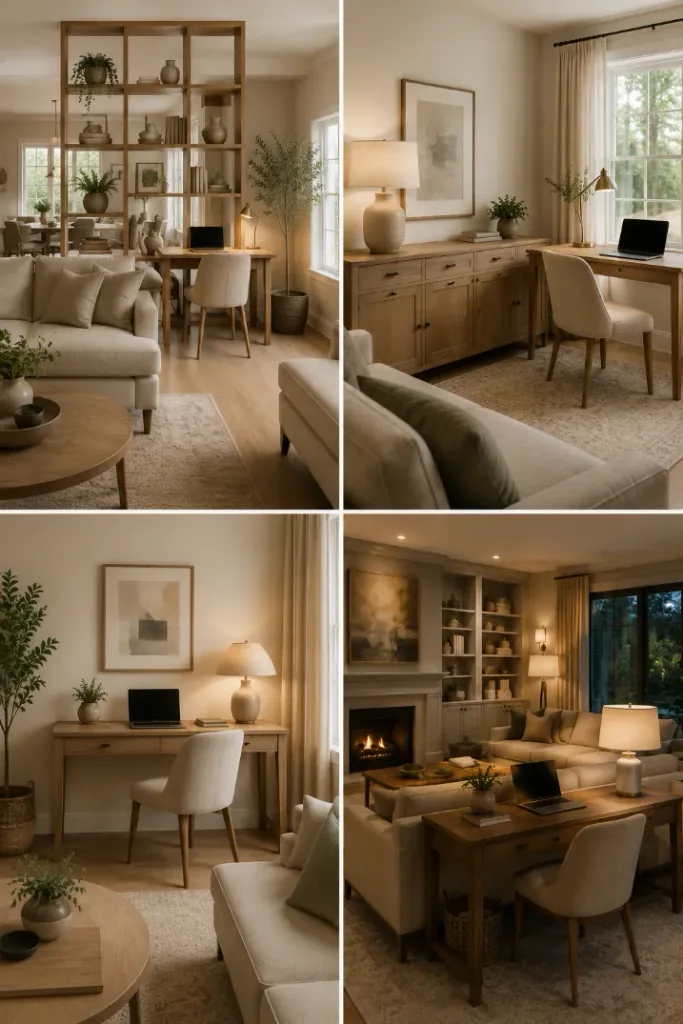
27. Repeat the Living Room Colors in the Office Area
This is another simple way to make the workspace disappear.
If your living room uses cream, oak, olive, and black, use those same colors at the desk.
Do not suddenly add a bright office chair and blue plastic storage.
Keep everything within the same palette.
The desk becomes just another part of the room.
I have found that color continuity can hide a workspace almost as well as actual doors.
28. Make the Office Easy to Pack Away
This is probably the most important idea for me.
If the living room is also your office, make it easy to stop working.
Use a laptop instead of a huge permanent setup if you can.
Keep a drawer nearby for chargers and notebooks.
Use baskets for paperwork.
Choose a desk that can be cleared in a minute.
When work is finished, put everything away.
I think that separation matters.
Your living room should still feel like a place to relax.
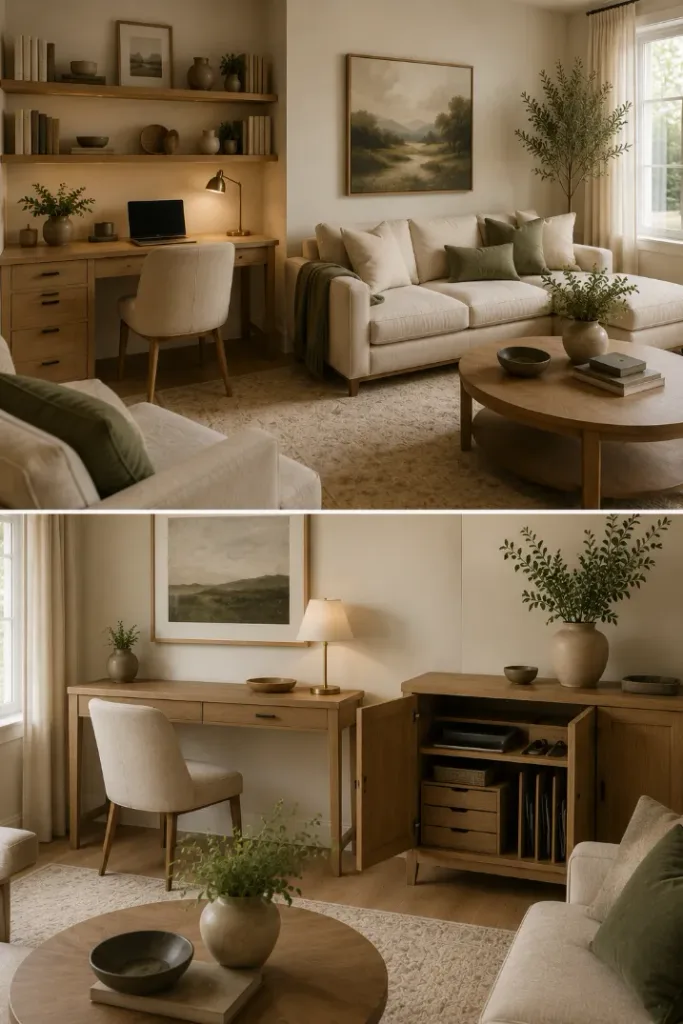
How I Would Arrange a Small Living Room Office Combo
If I had a small living room and needed a desk, I would start by looking for wasted space.
Usually that means:
- Behind the sofa
- Beside a window
- In an empty corner
- Between two windows
- Beside the TV unit
- Inside built-in shelves
- Inside a cabinet
- Under the stairs
I would avoid putting a large desk right in the middle unless the room is big enough.
Then I would choose a chair that blends with the living room and use closed storage for everything I do not want to see.
The desk should feel like one piece of the room.
Not a second room squeezed into the first one.
Living Room Office Combo Ideas for Small Apartments
For a very small apartment, I would keep everything as flexible as possible.
My favorite choices would be:
- Console table desk
- Floating desk
- Fold-down wall desk
- Secretary desk
- Small round table
- Desk built into shelving
- Window desk
- Slim desk behind the sofa
The smaller the room, the more I want each piece of furniture to do more than one job.
That is how you keep the room useful without filling every inch.
How to Hide a Desk in a Living Room
If your main goal is hiding the office, I would choose one of these approaches.
Put it inside cabinetry.
Probably the cleanest option.
Use a secretary desk.
Close the front and it becomes furniture.
Use a console-style desk.
It can look decorative when not in use.
Build it into shelves.
The desk becomes part of the wall.
Use the same colors and materials as the room.
The workspace visually disappears.
Keep the chair tucked in.
A chair sticking into the room makes the office feel much more obvious.
Hide cables.
Nothing makes a workspace look messier faster than cords.
What I Would Avoid
There are a few things I would be careful with.
A desk that is too deep.
It steals valuable living room space.
Huge office chairs.
They are comfortable, but they can take over the room visually.
Too much open office storage.
Paperwork is not decor.
Bright office accessories that do not match the room.
They immediately separate the workspace.
Blocking windows.
Natural light is too useful to lose.
Trying to fit a full office setup into a tiny corner.
Sometimes a laptop desk is all you need.
Leaving work visible all evening.
If possible, give yourself a way to pack it away.
Colors I Like for a Living Room Office Combo
I usually keep the workspace in the same palette as the rest of the room.
Some combinations I really like are:
- Cream + oak + olive green
- Warm white + walnut + black
- Beige + light wood + muted blue
- Soft taupe + cream + brass
- Ivory + dark wood + forest green
- Warm gray + oak + black
- Cream + walnut + rust
- Beige + pale wood + charcoal
The desk does not need to disappear completely.
It just should not feel like it came from a completely different room.
How I Would Make a Living Room Office Look More Expensive
I would focus more on materials than office accessories.
Use a good-looking wood desk.
Add one proper lamp.
Choose a chair with nice fabric.
Hide the cables.
Use framed artwork instead of office posters.
Add a small ceramic bowl or vase.
Keep storage closed.
And leave some empty space on the desktop.
That usually looks much better than filling the desk with organizers.
Final Thoughts
The best living room office combo ideas are the ones that make working easier without making the living room feel like an office.
That is the balance I would aim for.
Use a slim desk.
Take advantage of corners.
Build the workspace into storage when possible.
Choose a chair that blends in.
Hide paperwork and cables.
Repeat the same colors and materials throughout the room.
And most importantly, make sure you can mentally close the office at the end of the day.
You do not need a separate room to create a good workspace.
Sometimes all you need is one well-planned corner that quietly does its job and then disappears back into the living room when work is done.