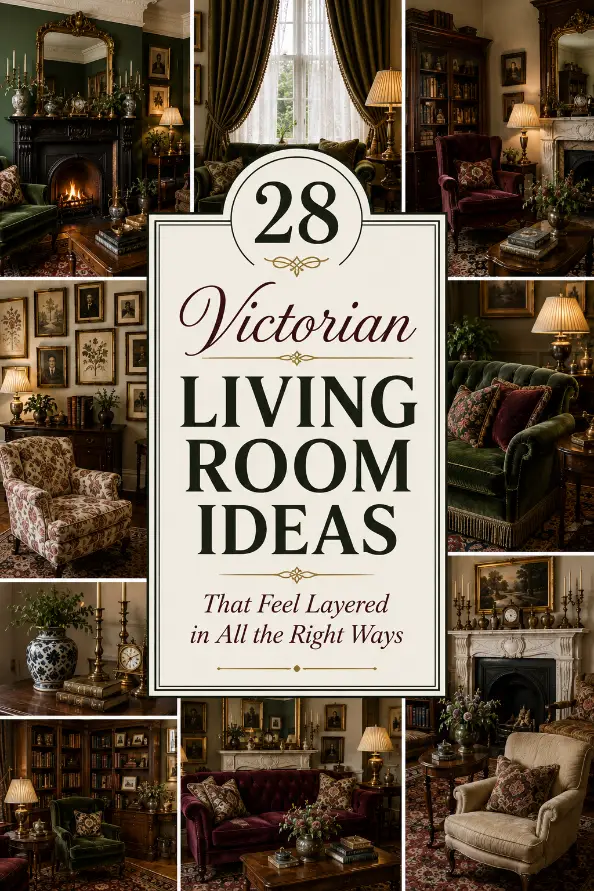
There is something about a Victorian living room that feels completely different from a newer space.
It is not just the furniture.
It is the layering.
The trim.
The darker woods.
The patterned rugs.
The old frames.
The lamps.
The little details that make the room feel as though it has been built up slowly instead of decorated in one weekend.
That is what I like most about Victorian interiors.
They do not have to be stiff or overly formal.
You can keep the beautiful architectural details and rich colors, then mix them with more comfortable furniture and softer styling.
For me, the best Victorian living rooms feel collected rather than perfect.
If you love rooms with depth, history, texture, and personality, these are the 28 Victorian living room ideas I would actually use.
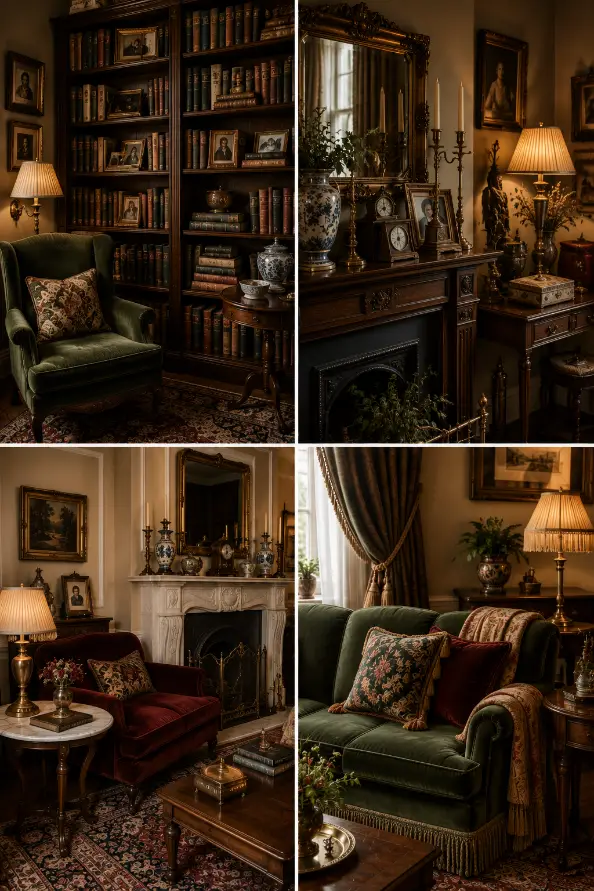
1. Start With Deep, Moody Wall Colors
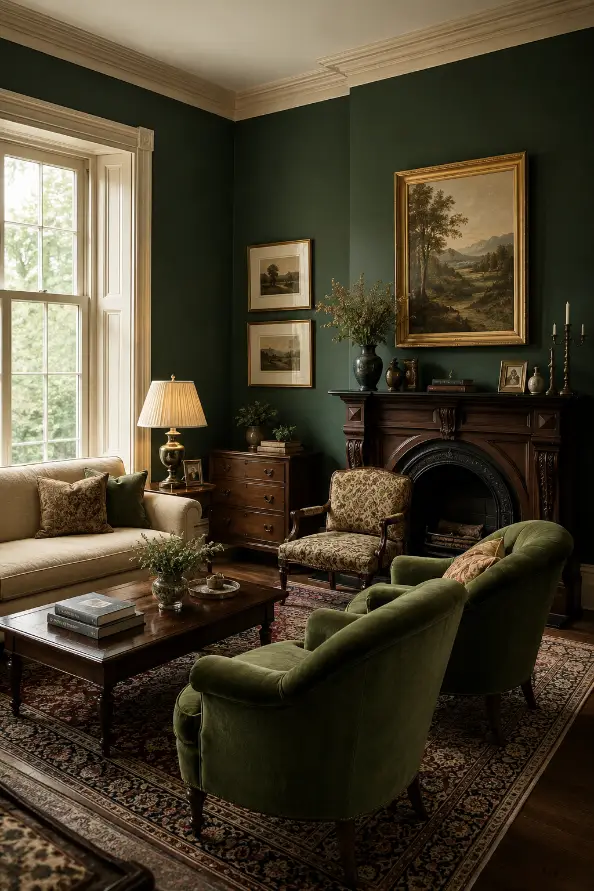
Victorian rooms can handle darker walls better than many modern spaces.
Deep green.
Warm brown.
Burgundy.
Charcoal.
Dusty blue.
Even a rich plum can work.
I would choose a color that feels slightly muted rather than very bright.
Dark walls instantly give the room more depth, especially when paired with white trim, warm wood, and antique-style lighting.
If the room gets good natural light, I would not be afraid of going fairly dark.
2. Keep the Original Molding Whenever You Can
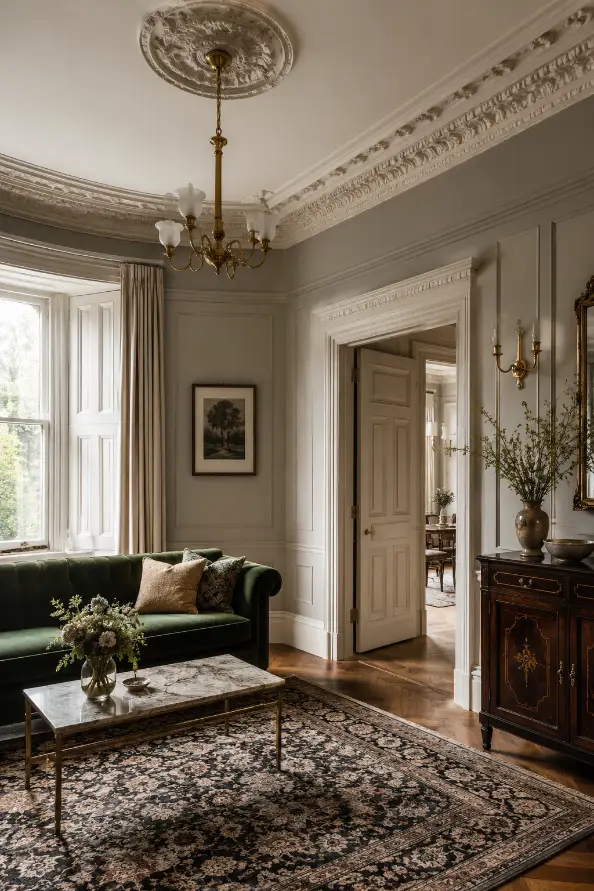
If your room already has decorative molding, I would keep it.
Crown molding.
Ceiling roses.
Picture rails.
Wall panels.
Decorative trim around doors.
These details are a huge part of what makes a Victorian room feel special.
Even if the rest of the room is fairly simple, the molding adds enough architecture to stop it from feeling plain.
If the molding is missing, adding simple panel molding can still create some of that layered character.
3. Paint the Trim in a Warm White
I usually prefer warm white trim in Victorian spaces.
Very bright white can feel too sharp against deeper wall colors.
Try ivory, soft cream, or a slightly warm off-white.
It softens the contrast.
It also works beautifully with antique wood furniture, brass lighting, faded rugs, and darker upholstery.
The whole room starts to feel older and more natural.
4. Use a Traditional Fireplace as the Main Focal Point
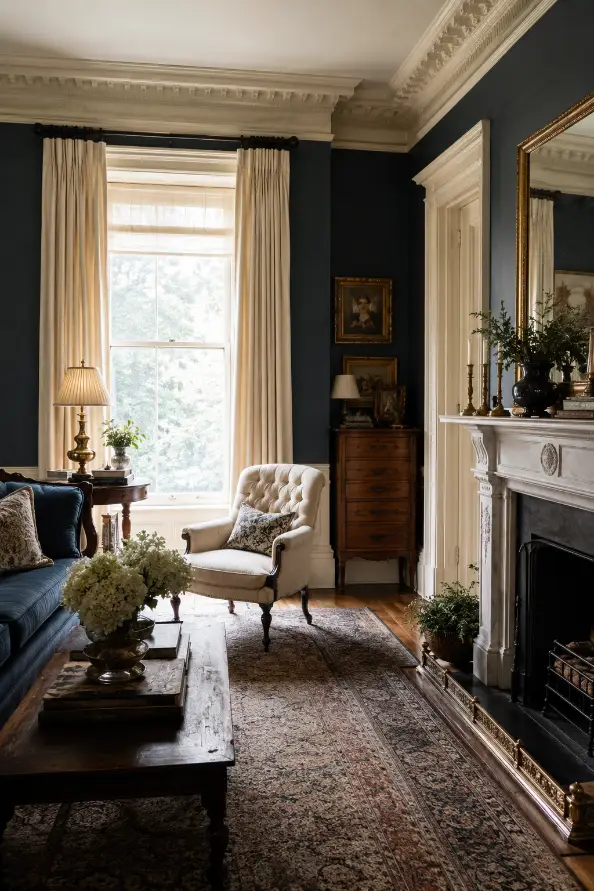
A fireplace feels completely at home in a Victorian living room.
If you already have one, I would build the seating arrangement around it.
Add artwork or a mirror above.
Place lamps nearby.
Maybe add a pair of chairs angled toward the fire.
Stone, marble, wood, and cast iron all work beautifully.
Even if the fireplace is no longer functional, it can still become the visual center of the room.
5. Hang an Ornate Mirror Above the Fireplace
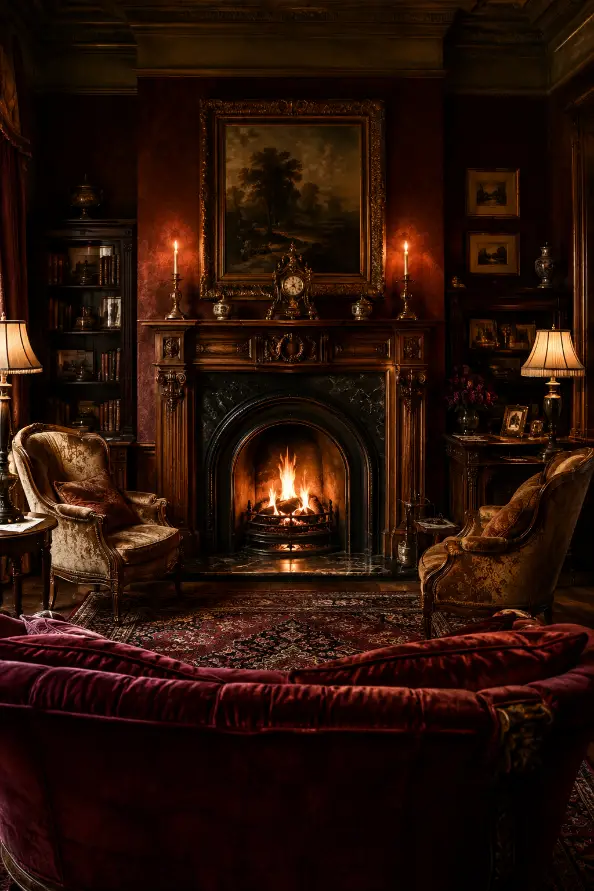
An ornate mirror is one of the easiest ways to make a Victorian room feel richer.
I like aged gold or dark wood frames.
Not overly shiny.
Something with a little detail and weight.
Place it over the mantel and let it reflect the room.
It adds height.
It bounces light around.
And it makes the fireplace feel more important.
6. Add a Velvet Sofa
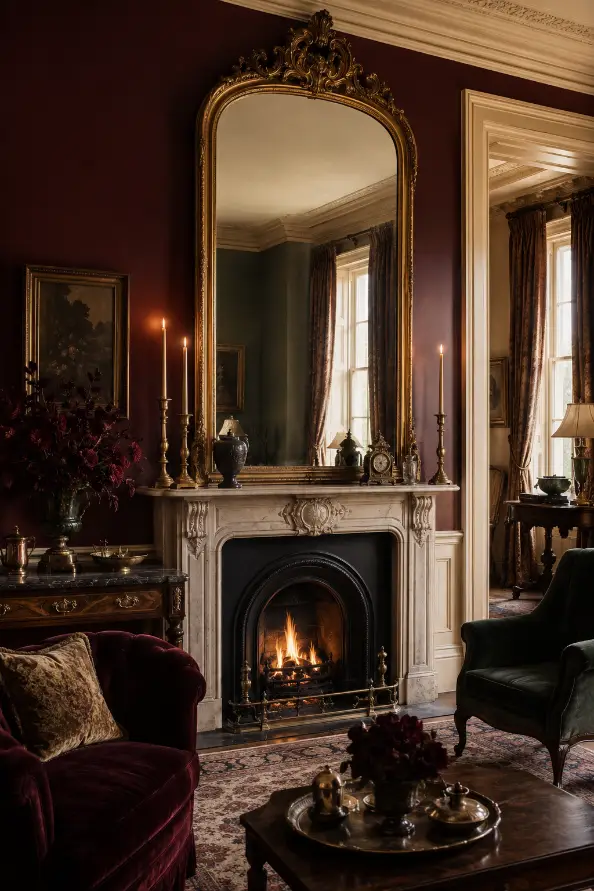
Velvet works so naturally in Victorian interiors.
Deep green.
Rust.
Plum.
Navy.
Brown.
Even a muted mustard can look beautiful.
I would choose a sofa with a slightly traditional shape but still make sure it is comfortable.
You do not need something that looks like a museum piece.
The fabric alone can give the room plenty of richness.
7. Pair the Sofa With Antique-Style Armchairs
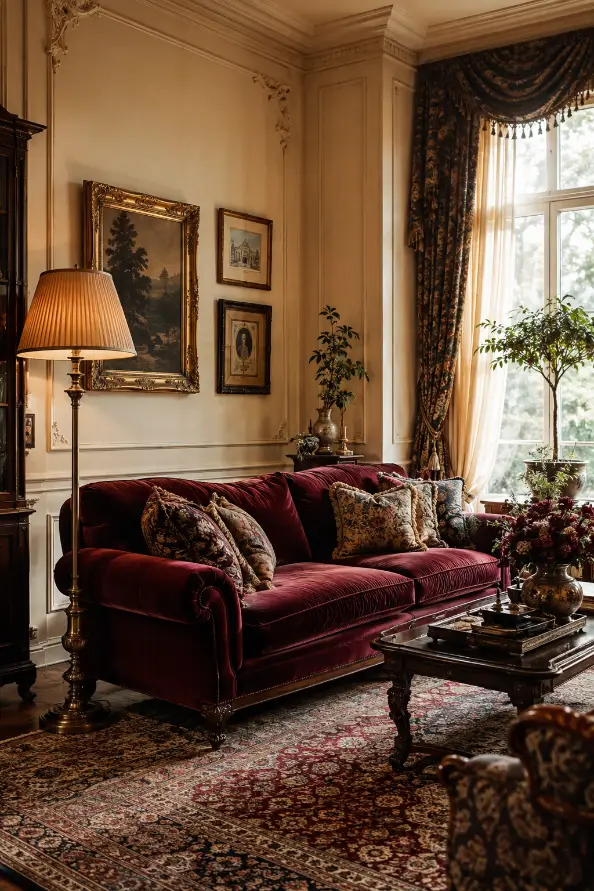
I like mixing the main sofa with chairs that have more character.
Maybe a carved wood armchair.
A wingback chair.
A floral upholstered chair.
Or a small velvet chair with curved arms.
The chairs do not need to match the sofa.
Actually, I prefer when they do not.
A little difference makes the room feel collected.
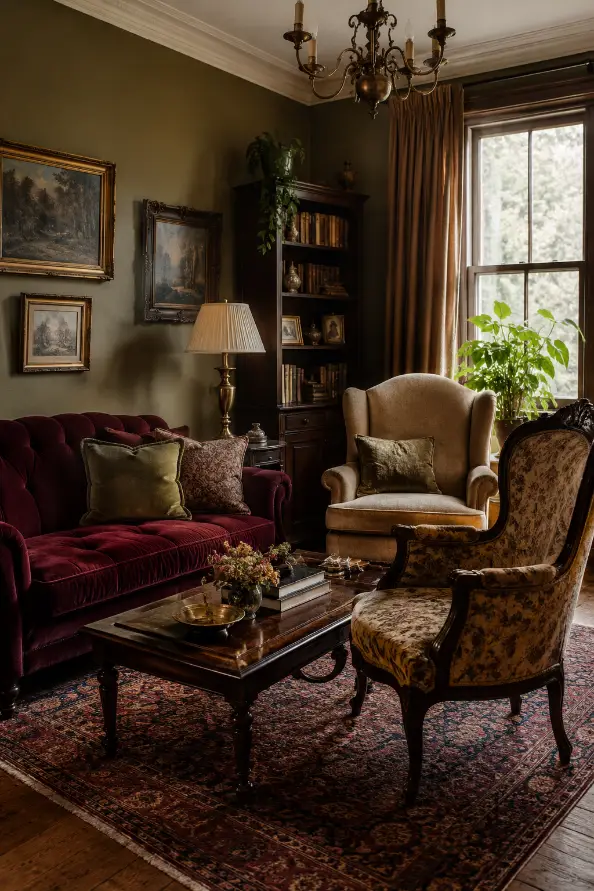
8. Use a Persian-Style Rug
A patterned rug is almost essential if you want that layered Victorian feeling.
I would look for faded reds, navy, olive, brown, cream, or dusty blue.
The rug should have enough pattern to anchor the room but not so much that it fights with everything else.
And I would go large.
A small rug can make a Victorian room feel broken up.
A larger one ties the furniture together and makes the whole room feel more established.
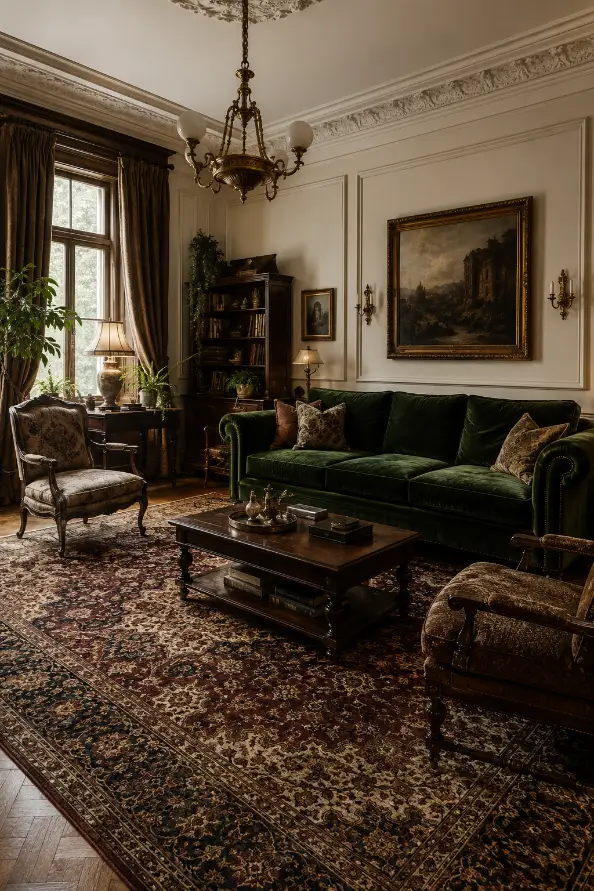
9. Add Dark Wood Furniture
Victorian rooms look especially good with darker woods.
Walnut.
Mahogany.
Dark oak.
You could use them in:
- Coffee tables
- Side tables
- Bookcases
- Consoles
- Display cabinets
I would not make every piece dark.
But one or two substantial wood pieces add weight.
They also keep the room from feeling too light or newly decorated.
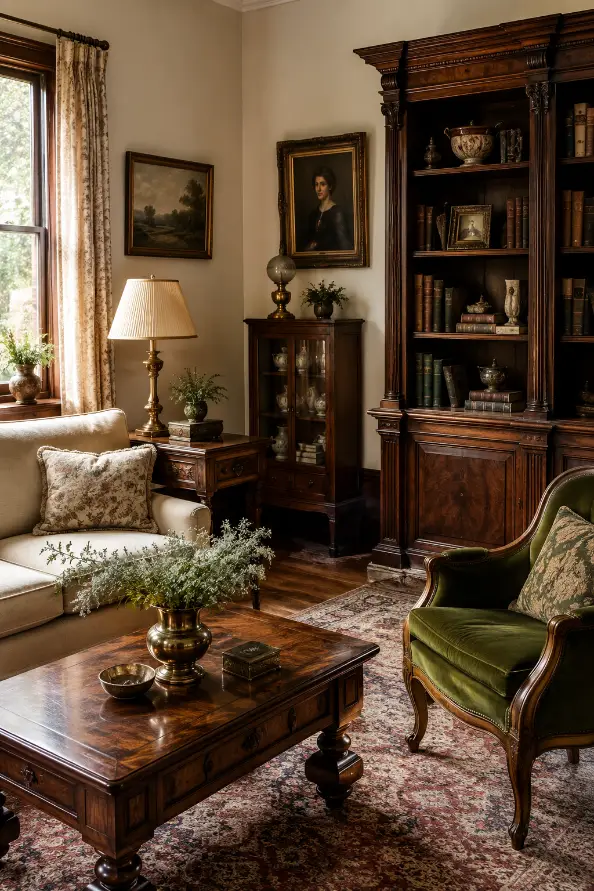
10. Mix Different Wood Tones
Even though I like dark wood, I would not worry about making every wood finish match.
Old rooms rarely feel perfectly coordinated.
A walnut table can sit next to a lighter oak chair.
A mahogany cabinet can work with a medium wood floor.
The variation makes the space feel more natural.
As long as the overall colors feel warm, mixed woods can work beautifully.
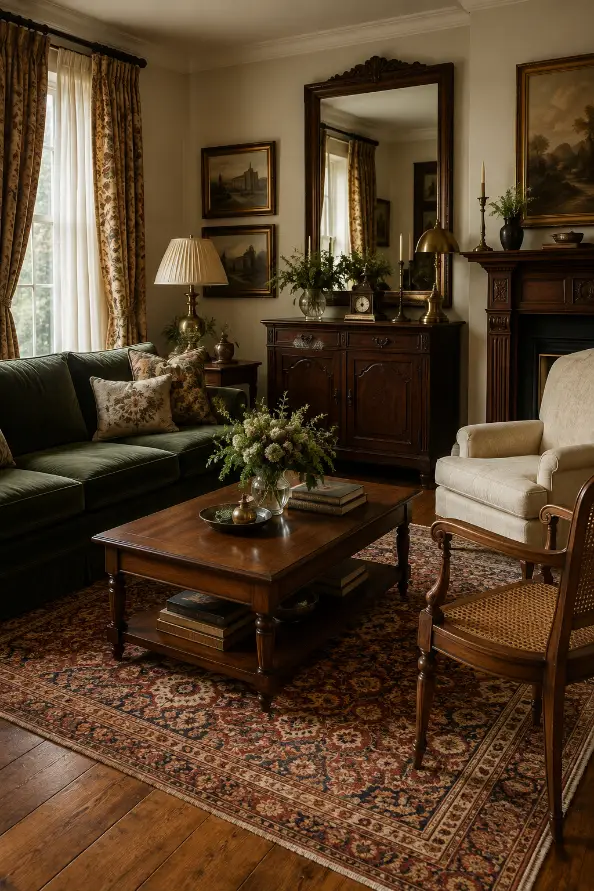
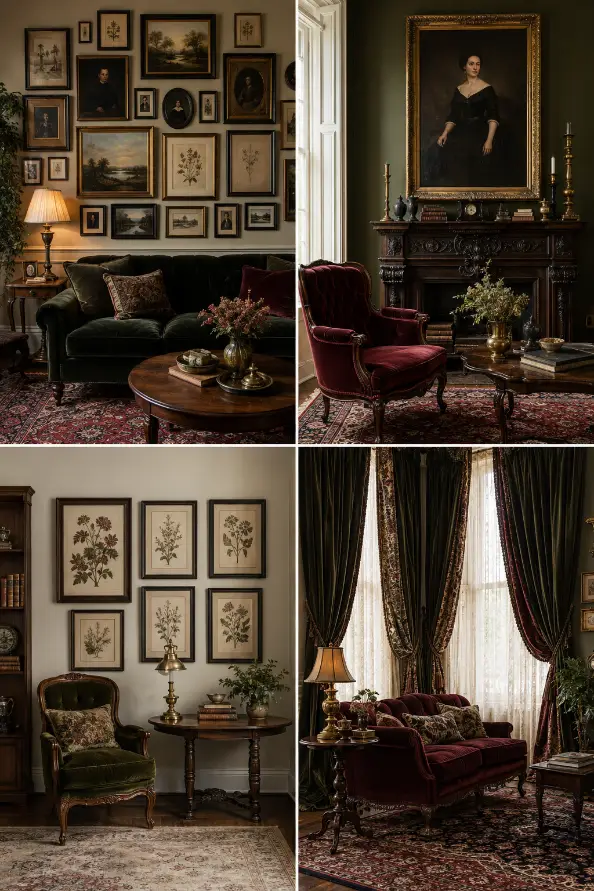
11. Create a Gallery Wall With Old-Style Art
A gallery wall is perfect for a Victorian living room.
I would mix landscapes, portraits, botanical prints, sketches, and maybe a small still life.
Use frames in:
- Dark wood
- Aged brass
- Black
- Antique gold
Do not make the frames identical.
I like when they feel collected over time.
Keep the spacing close enough that the group feels connected.
12. Use One Large Portrait for Drama
If a gallery wall feels too busy, one large portrait can be even more powerful.
It does not have to be a real family portrait.
A vintage-style painting or reproduction can work.
I would place it above a console, fireplace, or sofa.
A large portrait adds that sense of history that Victorian rooms do so well.
13. Add Botanical Prints
Botanical art gives a Victorian room a softer side.
I especially like smaller botanical prints grouped together.
Maybe four or six in simple frames.
They work well near a reading chair, above a small table, or beside a bookcase.
Muted greens and cream paper tones blend easily with darker furniture and richer wall colors.
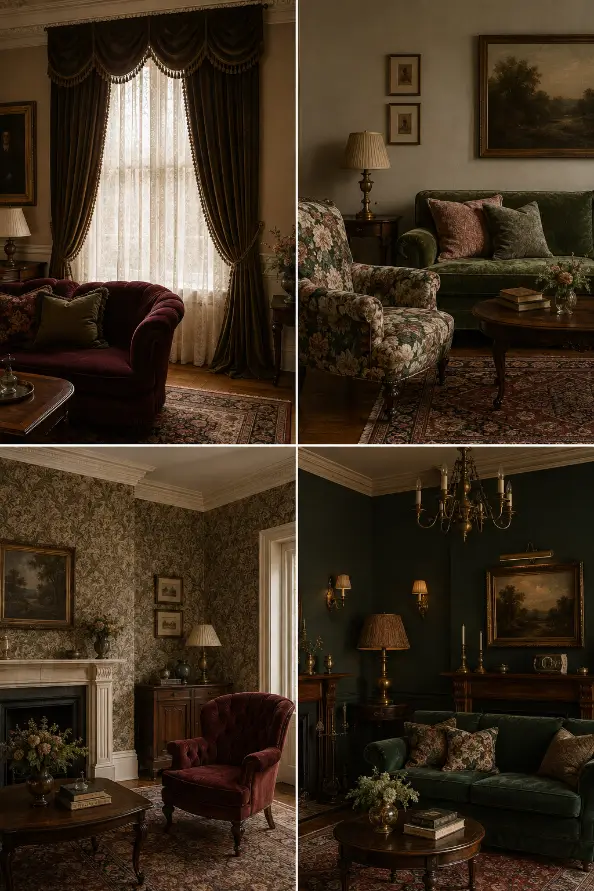
14. Use Heavy Curtains With Plenty of Fabric
Victorian windows often look best with fuller curtains.
I would hang them high and let them fall all the way to the floor.
Velvet can be beautiful in a dramatic room.
Linen or heavier cotton works if you want something softer.
I would avoid very thin curtains unless they are layered with something heavier.
The extra fabric makes the room feel more finished.
15. Layer Sheer Curtains Behind Heavier Drapes
This is one of those small details that makes a room feel much more complete.
Use soft sheer curtains closest to the window.
Then add heavier drapes outside them.
The sheers soften daylight.
The outer curtains add weight and privacy.
Together, they create that layered window treatment I associate with older homes.
16. Bring in Floral Patterns
Florals can work beautifully in Victorian spaces.
But I would use them carefully.
Maybe one floral chair.
A few cushions.
Curtains.
Or wallpaper on one wall.
Choose patterns that feel slightly muted and traditional.
Deep green, rust, cream, dusty rose, brown, and blue all work well.
You do not need floral everything.
One strong pattern can be enough.
17. Try Traditional Wallpaper
Wallpaper can instantly give the room more history.
I like:
- Small florals
- Damask
- Botanical prints
- Subtle stripes
- Heritage-style patterns
If doing all four walls feels like too much, use wallpaper above panel molding or on one focal wall.
Then keep the rest of the room quieter.
That way, the pattern feels intentional rather than overwhelming.
18. Add Brass Lighting
Aged brass works beautifully with Victorian interiors.
Try a brass floor lamp.
Wall sconces.
Picture lights.
Table lamps.
Or a chandelier.
I prefer brass with a softer, aged finish rather than something very shiny.
It adds warmth without making the room feel flashy.
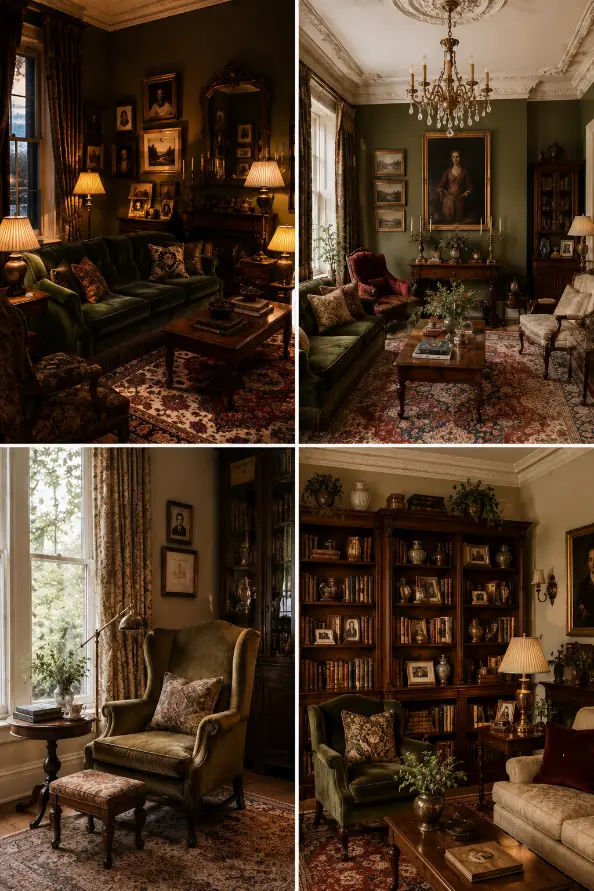
19. Use Table Lamps Instead of Relying on Ceiling Lights
I think Victorian-style rooms look much better with several smaller light sources.
One ceiling fixture is rarely enough.
Add table lamps beside the sofa.
Use a floor lamp near a reading chair.
Maybe place a small lamp on a console.
The lower lighting creates pools of warmth around the room.
That makes everything feel cozier in the evening.
20. Add a Traditional Chandelier
A chandelier can make the room feel instantly more architectural.
It does not need to be huge.
A smaller brass chandelier, glass fixture, or antique-inspired design can still have a big impact.
If the ceiling has a decorative rose, the effect is even better.
I would make sure the chandelier fits the room rather than overpowering it.
Scale matters.
21. Create a Proper Reading Corner
Victorian living rooms almost beg for a reading corner.
I would use one comfortable armchair.
Add a small side table.
A floor lamp.
Maybe a footstool.
And place it near a window or bookcase.
The setup does not need to be large.
It just needs to feel intentional.
This kind of corner makes the room feel lived in.
22. Add Built-In or Freestanding Bookcases
Books bring instant depth to a room.
I especially like tall dark wood bookcases in Victorian spaces.
Fill them with books, framed photos, pottery, and a few decorative objects.
Do not style every shelf perfectly.
Leave some shelves fuller.
Others lighter.
That slight irregularity makes the room feel more believable.
23. Display Books Horizontally and Vertically
This is a small styling trick, but it helps.
Do not line every book up the same way.
Stand some upright.
Stack a few horizontally.
Place a small object or framed photo on top of a stack.
It makes the shelves feel more relaxed.
I want the room to look like the books are actually used, not staged for a photo.
24. Add Decorative Objects Slowly
Victorian rooms often have lots of objects, but I would not buy everything at once.
Collect slowly.
Ceramic vases.
Old boxes.
Candlesticks.
Small sculptures.
Framed photographs.
Interesting bowls.
A magnifying glass.
Maybe a vintage clock.
The room looks more authentic when the objects feel unrelated but still somehow work together.
25. Use Marble in Small Amounts
Marble works beautifully with Victorian style.
You could use it on:
- A fireplace surround
- Side table
- Console top
- Small pedestal
- Lamp base
I would keep it limited.
A little marble adds elegance.
Too much can make the room feel colder than I want.
Pair it with wood, velvet, rugs, and warm lighting.
26. Add a Touch of Fringe or Tassels
Small decorative details can make the room feel more layered.
A tasseled cushion.
Fringe on a lampshade.
A decorative trim on curtains.
A throw with a soft edge.
I would use these details sparingly.
They are most effective when they feel like little surprises rather than the main feature.
27. Mix Victorian Pieces With Comfortable Modern Furniture
This is probably my favorite way to use Victorian style.
I would not make every piece traditional.
Keep the ornate mirror.
The dark wood table.
The patterned rug.
The brass lamps.
Then add a comfortable modern sofa or simpler armchair.
That mix stops the room from feeling like a period set.
It makes it easier to live in.
28. Let the Room Feel Collected Instead of Perfect
This is the biggest thing I would remember.
A Victorian living room should not feel too controlled.
The frames do not all need to match.
The furniture does not all need to come from the same set.
The wood tones can vary.
The cushions can be different.
The art can be a little unexpected.
That is where the charm comes from.
New rooms often look finished very quickly.
Victorian-inspired rooms feel better when they seem to have grown over time.
For me, that is exactly what gives them character.
My Favorite Victorian Living Room Color Combinations
Some combinations I would happily use are:
- Deep olive + cream + walnut
- Burgundy + warm white + antique brass
- Charcoal + rust + dark wood
- Dusty blue + brown + ivory
- Forest green + faded red + mahogany
- Plum + beige + brass
- Warm brown + cream + olive
- Navy + rust + antique gold
I usually like one dark main color, one lighter neutral, and one warm material.
That gives the room depth without making it feel too busy.
How I Would Make a Victorian Living Room Feel Cozy
I would focus on softness.
Use a large rug.
Layer curtains.
Add lamps at different heights.
Choose upholstered seating.
Bring in velvet, wool, linen, and woven cushions.
Use darker wood.
Add books.
And make sure the room has enough warm light at night.
Victorian style can look formal in photos, but it does not need to feel formal in real life.
The room should still be comfortable enough to sit in every day.
How I Would Make It Feel Less Heavy
Victorian rooms can become dark quickly.
If that worries you, I would balance the richer details with lighter elements.
Use warm white trim.
Keep the ceiling light.
Add cream upholstery.
Use mirrors.
Choose lighter curtains in some areas.
And leave some walls less decorated.
You do not need pattern on every surface.
A little breathing room makes the historic details stand out more.
What I Would Avoid
There are a few things I would be careful with.
Buying a complete matching furniture set.
It can make the room feel staged instead of collected.
Using too many decorative objects at once.
Layered does not have to mean cluttered.
Very bright modern white paint everywhere.
It can make antique-style furniture feel disconnected.
Tiny rugs.
Large rooms need rugs with enough scale.
Too much shiny gold.
Aged brass or antique gold usually feels softer.
Making everything dark.
Use cream, ivory, mirrors, and natural light to balance the richer colors.
Trying to make the room look historically perfect.
I would rather make it comfortable and personal.
Final Thoughts
What I love most about Victorian living room ideas is that they give you permission to layer things.
You can mix old and new.
Dark and light.
Plain and patterned.
Wood and velvet.
Brass and marble.
Art and books.
And the room does not have to look perfect.
In fact, I think it looks better when it does not.
If I were starting from scratch, I would begin with one rich wall color, a large patterned rug, a comfortable sofa, dark wood, warm lighting, and a few pieces of art.
Then I would let the rest build slowly.
That is how you get a room that feels layered.
Not decorated all at once.
And that slightly imperfect, collected feeling is exactly what makes Victorian living rooms so hard to copy in a brand-new space.