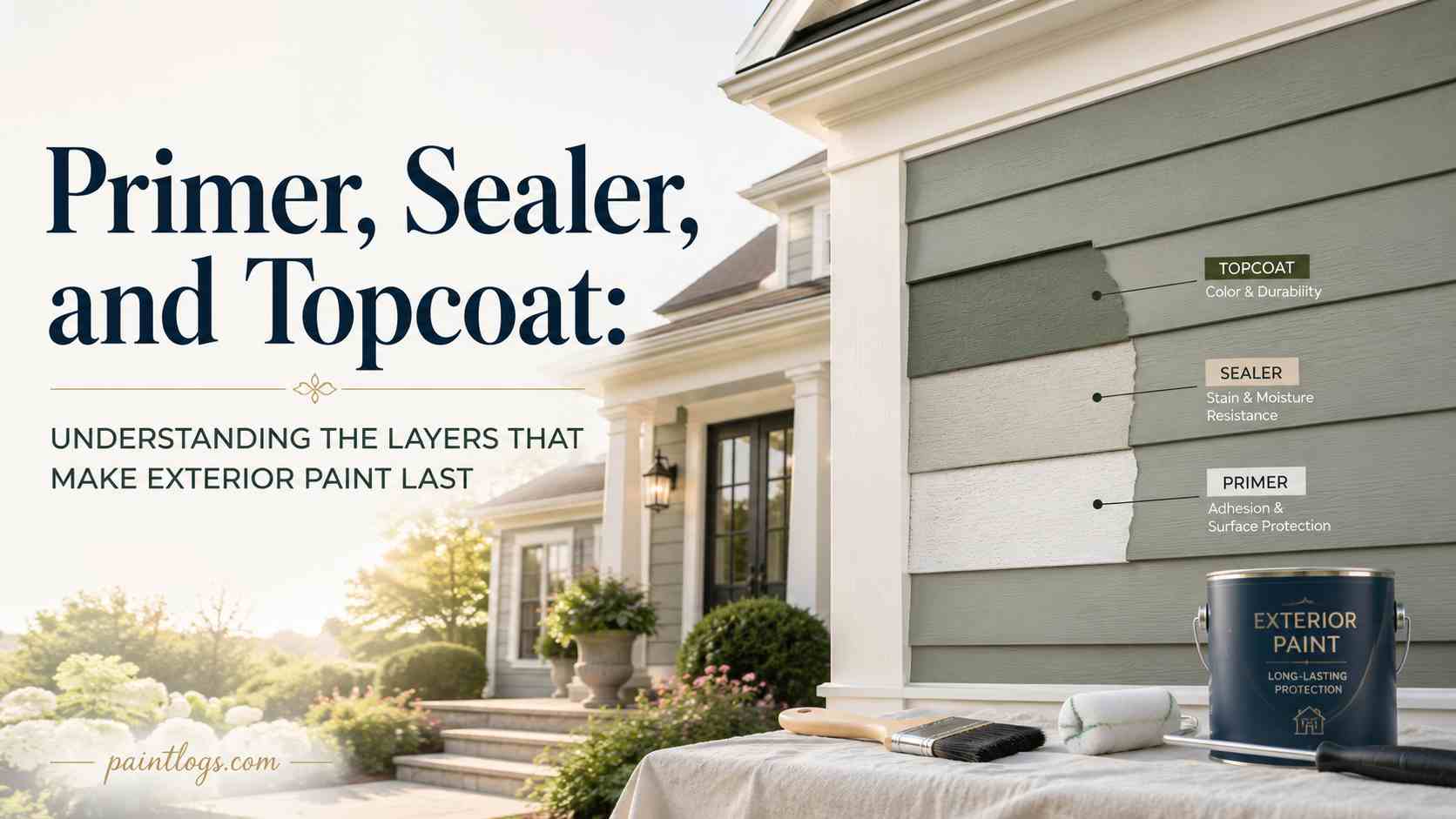
Primer Sealer and Topcoat: Understanding the Layers That Make Exterior Paint Last
What goes on before the topcoat matters as much as the topcoat itself. Here’s a clear guide to the role each layer plays in a lasting exterior paint system.
When most homeowners think about exterior painting, they think about the color they’ll see — the topcoat that gives the home its appearance. What they rarely think about are the layers that go on before the color: primers, sealers, and specialty coatings that do work the topcoat alone cannot do. These layers are the foundation of a paint system that holds up for years rather than failing prematurely.
Understanding what each layer does — and why professional painters use them even when they add cost and time to the project — helps homeowners evaluate quotes intelligently, understand why preparation and priming matter, and recognize the difference between a complete paint system and a job that cuts corners in ways that won’t be obvious until months after the painter has left.
What Primer Actually Does
Primer is not paint applied to save on topcoat — it’s a different product formulated to perform a specific function that topcoat isn’t designed to do. The primary functions of primer are adhesion promotion and sealing.
Adhesion promotion refers to creating a surface that the topcoat can bond to reliably — primer penetrates the substrate and creates a more consistent, bondable surface than bare wood, metal, or weathered paint. Sealing refers to controlling the porosity of the surface so that the topcoat can be applied at consistent film thickness rather than being unevenly absorbed.
Without primer on bare wood, the first coat of topcoat is partially absorbed into the wood fiber rather than remaining at the surface as a film. This produces thin, uneven coverage that requires more topcoat to achieve comparable film build — and even then, adhesion is typically inferior to a primed surface.
On previously painted surfaces in good condition, primer may not be necessary; on bare wood, new drywall, repaired patches, or heavily weathered surfaces, primer is an essential component of a system that will hold up.
Specialty Primers for Specific Situations
Different surface conditions require different primer formulations. Stain-blocking primers seal in tannins from wood species like cedar and redwood that bleed through standard topcoats, and they cover existing stains — from water damage, smoke, or other sources — that regular primer and topcoat cannot hide.
Bonding primers are formulated for difficult-to-coat surfaces like aluminum, glossy existing paint, or masonry where standard primers don’t achieve adequate adhesion. High-build primers are used on rough or uneven surfaces to create a more uniform substrate before topcoat application.
Experienced exterior painting Waco TX professionals select the primer based on the specific surface condition rather than using a universal primer for every application.
Rust-inhibiting primers for metal surfaces represent another specialty category important for exterior work. Bare metal and weathered painted metal are both vulnerable to rust initiation, and a rust-inhibiting primer creates a barrier that slows or prevents this process under the topcoat. For exposed metal elements on a home’s exterior — railings, downspouts, decorative metalwork — proper primer selection is as important as topcoat selection.
Sealers and Their Role
Sealers serve a different function than primers — where primer promotes adhesion, sealer primarily controls porosity and prevents moisture movement through the coating system. On highly porous surfaces like concrete, masonry, or certain wood species, a sealer applied before primer and topcoat creates a more consistent surface that performs better over time by limiting moisture’s ability to migrate through the substrate and affect adhesion from below.
Deck sealers and penetrating wood sealers are common in exterior applications where the goal is to protect wood from moisture absorption rather than to create a solid film over the surface. These products work differently from paint systems — they penetrate into the wood fiber and stabilize it against moisture movement rather than forming a film on top. For certain exterior wood elements where a natural wood look is preferred, sealers rather than paint systems may be the appropriate product choice.
The Topcoat System and Why Two Coats Matters
The topcoat is the visible layer that provides color, sheen, and the majority of the weather protection function. Two coats of topcoat — rather than one thick coat — produce better film integrity than equivalent material applied in a single application.
Each coat is applied at the proper wet film thickness, allowed to dry fully, and then the second coat is applied over a surface that’s already uniform and bonded. The result is a complete, consistent film with better coverage, better color uniformity, and better long-term performance than a single heavy application.
The temptation to apply one thick coat to speed a project along is one of the more common quality shortcuts in exterior painting. A thick single coat is more prone to running, sagging, and developing surface defects as it dries.
It also tends to produce a film that’s weaker in adhesion and more vulnerable to failure at the substrate interface than two properly applied coats. The time investment of allowing the first coat to dry properly before applying the second is inseparable from the quality of the final result.
Surface Condition and System Selection
The right coating system for any exterior surface begins with an honest assessment of the substrate condition. A surface in good condition — existing paint that’s sound, clean, and well-adhered — may need only light preparation and a primer in specific areas before topcoat.
A surface with failing paint, bare wood areas, moisture damage, or extensive staining needs a more comprehensive system that addresses each of those conditions before topcoat is applied.
Bidding exterior paint work without inspecting the surface condition produces quotes that are either too high (assuming more preparation than is needed) or too low (not accounting for the preparation that is needed).
Professional painters who include a detailed surface inspection in their quoting process are giving you a quote based on what your specific home actually needs — not a generic estimate that may bear little resemblance to what the job requires.
Long-Term Performance and System Integrity
The difference between an exterior paint system that lasts 8 to 10 years and one that begins failing in 3 to 4 is primarily in the preparation and primer stages rather than in the topcoat brand. Premium topcoat applied over inadequate preparation will fail from the substrate side — through adhesion loss, moisture intrusion, and substrate deterioration — regardless of how good the topcoat product itself is. The complete system, executed correctly from surface prep through topcoat, is what delivers long-term performance.
This is why paint quotes that focus exclusively on topcoat brand and price without addressing preparation, primer, and application quality are incomplete. The paint material is the smallest cost component of most professional exterior painting jobs — labor and time are the larger factors. A quote that’s low because preparation and primer are being minimized is a quote that’s shifting cost from the contractor to the homeowner in the form of earlier failure and more frequent repainting.
Wrapping Up
A complete exterior paint system is more than the visible color coat — it’s a layered system where primer and sealer create the conditions for topcoat to perform. Understanding the role of each layer helps homeowners evaluate painting quotes accurately, understand why thorough preparation and proper priming add value rather than cost, and set realistic expectations for how long a quality paint job should last.
The investment in a properly complete paint system pays off every year in the form of better appearance retention and a longer interval before the next repaint is needed.
Frequently Asked Questions
How can I tell if my existing exterior paint needs primer before repainting?
Any area where the existing paint has been scraped, sanded, or otherwise removed to reveal bare substrate needs primer before topcoat. Areas with significant chalking, staining, or where previous paint was a much darker color than the new topcoat also typically benefit from primer.
Sound, clean, existing paint that’s being recoated in a similar color may not require full-coverage primer, though spot-priming any repaired areas is still best practice.
Do oil-based and water-based primers work the same way?
They serve similar functions but have different properties. Oil-based primers penetrate wood more deeply, provide excellent stain blocking, and can be applied in a wider range of temperatures and humidity levels. Water-based primers are lower VOC, faster drying, and easier to clean up, but may not penetrate certain surfaces as deeply.
Premium water-based formulations have significantly closed the performance gap in recent years, making oil-based primers primarily the choice for specific difficult substrate conditions rather than a universal preference.