
Making a home look expensive has surprisingly little to do with filling it with expensive things.
In fact, some homes have beautiful furniture and costly finishes but still feel unfinished. Others use fairly ordinary pieces and somehow look thoughtful, established, and much more luxurious.
For me, the difference is usually scale, architecture, materials, and restraint.
A curtain hung too low can make an expensive room look cheaper. A properly sized piece of artwork can make a basic wall suddenly feel intentional. Painting an overlooked ceiling or replacing one generic light fixture can sometimes have more impact than buying several new accessories.
I also think the most interesting homes aren’t perfectly coordinated. They combine something old with something new, allow natural materials to show their imperfections, and don’t decorate every empty surface.
So these aren’t 25 versions of “add a vase and some pillows.”
I’ve deliberately chosen ideas that can create visually different rooms and transformations—which means some are architectural, some involve color, some are about furniture, and others are surprisingly simple changes.
Here are 25 ways I’d make a home feel more expensive without turning it into a showroom.
1. Paint the Ceiling Instead of Leaving It White
The ceiling is probably the largest forgotten decorating surface in most homes.
Instead of automatically leaving it bright white, try giving it a deliberate color.
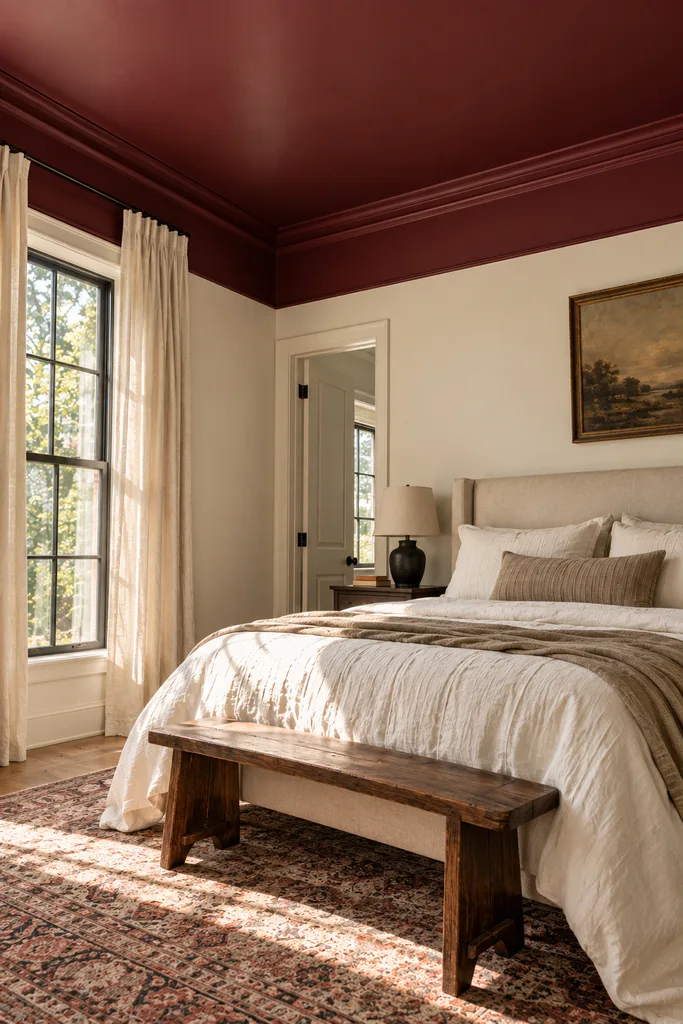
In a bedroom, a muted olive, dusty blue, mushroom, or deep burgundy ceiling can make the room feel much more enveloping. In a lighter room, even a warm cream that’s slightly deeper than the walls can make the architecture feel considered.
I particularly like this idea in rooms with crown molding because the contrast makes the detail more noticeable.
You don’t necessarily need a dramatic color. The important part is making the ceiling feel like a design decision rather than an area nobody thought about.
2. Use One Oversized Piece of Artwork
A wall covered with lots of tiny decorations can sometimes make a room feel busier rather than better.
Try the opposite.
Hang one genuinely large piece of artwork above a sofa, console, bed, or dining table.
The artwork should have enough scale to visually relate to the furniture beneath it. A tiny frame floating above a six-foot sofa rarely has the same impact.
You don’t need an expensive original painting either. Large photography, textile art, vintage prints, or affordable canvas pieces can work.
I’d rather have one confident piece than twelve small things trying to fill the same wall.
3. Hang Curtains Almost From Ceiling to Floor
Curtains can change the perceived proportions of a room.
Instead of mounting the rod directly above the window frame, take it higher—often close to the ceiling or crown molding.
Let the curtains fall almost all the way to the floor.
I also like extending the rod beyond the sides of the window so the curtains sit partly against the wall when they’re open. This exposes more glass and can make the window appear wider.
Choose fabric with some natural movement, such as linen or a linen-look material.
The result feels much more intentional than short curtains ending somewhere around the windowsill.
4. Add an Interior Archway
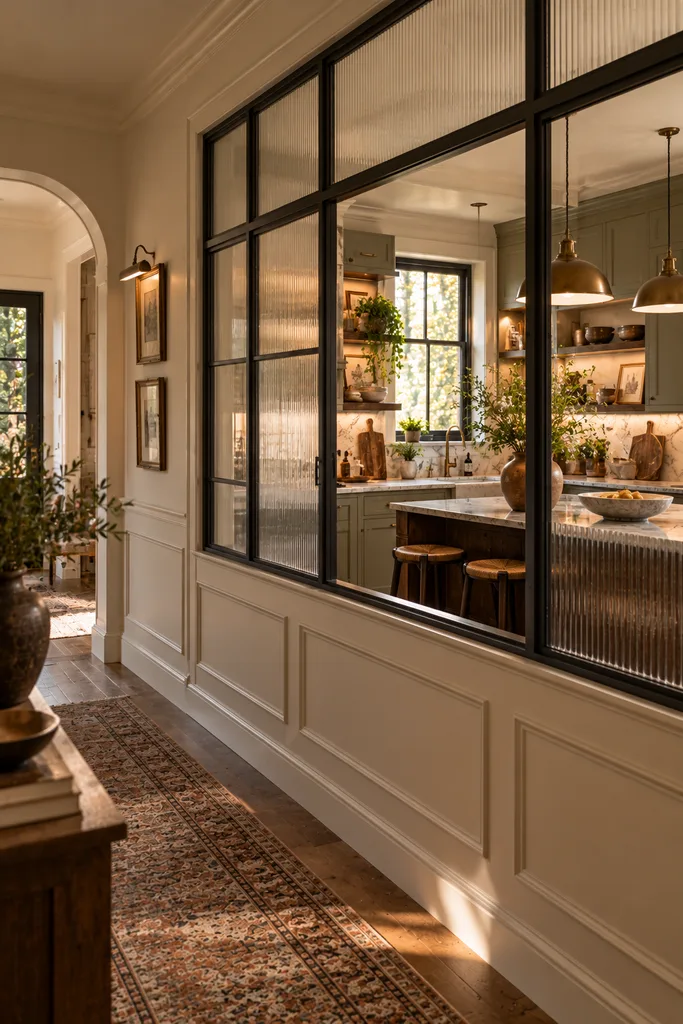
A simple doorway does its job, but an arch can turn the transition between two rooms into an architectural feature.
This works especially well between a living room and dining room, kitchen and breakfast area, or hallway and main living space.
The arch doesn’t need decorative columns or complicated trim.
A clean plaster curve can actually feel more sophisticated.
If changing the structure isn’t realistic, you can sometimes create a similar effect around an existing wide opening with carefully designed trim.
This is one of those changes that makes the house itself interesting before you add any furniture.
5. Add Picture-Frame Molding to a Plain Wall
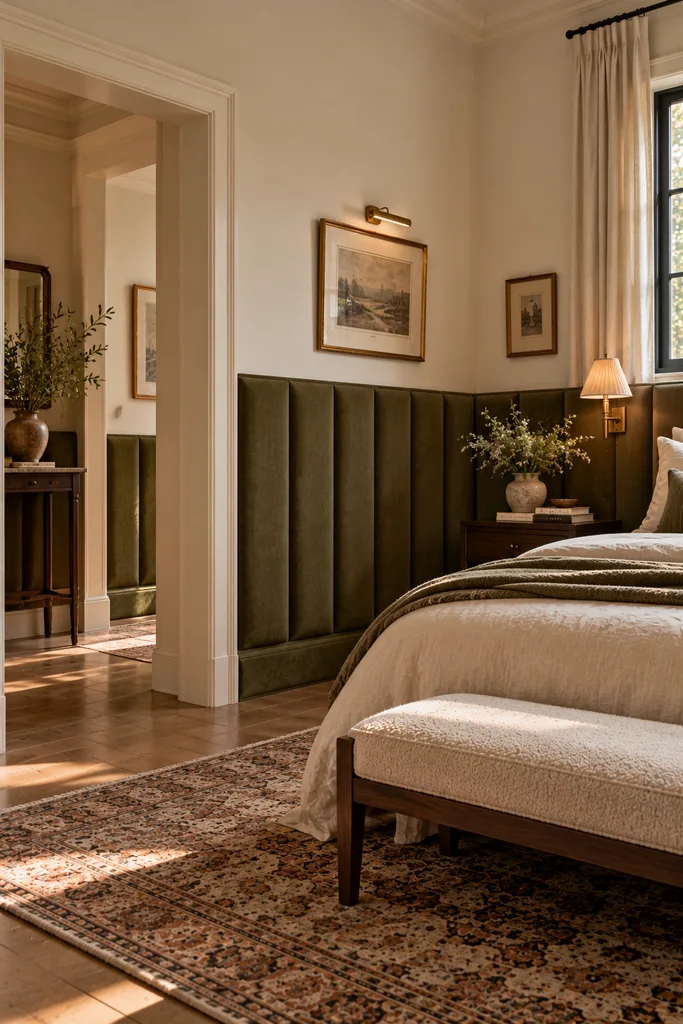
Picture-frame molding can give a completely ordinary wall much more depth.
I prefer simple rectangular molding painted the same color as the wall rather than high-contrast trim.
That keeps the effect architectural instead of decorative.
It can work behind a bed, along a hallway, throughout a dining room, or across a living-room wall.
You can leave the panels mostly empty too.
You don’t need to place artwork inside every rectangle. Sometimes the shadows created by the molding are enough.
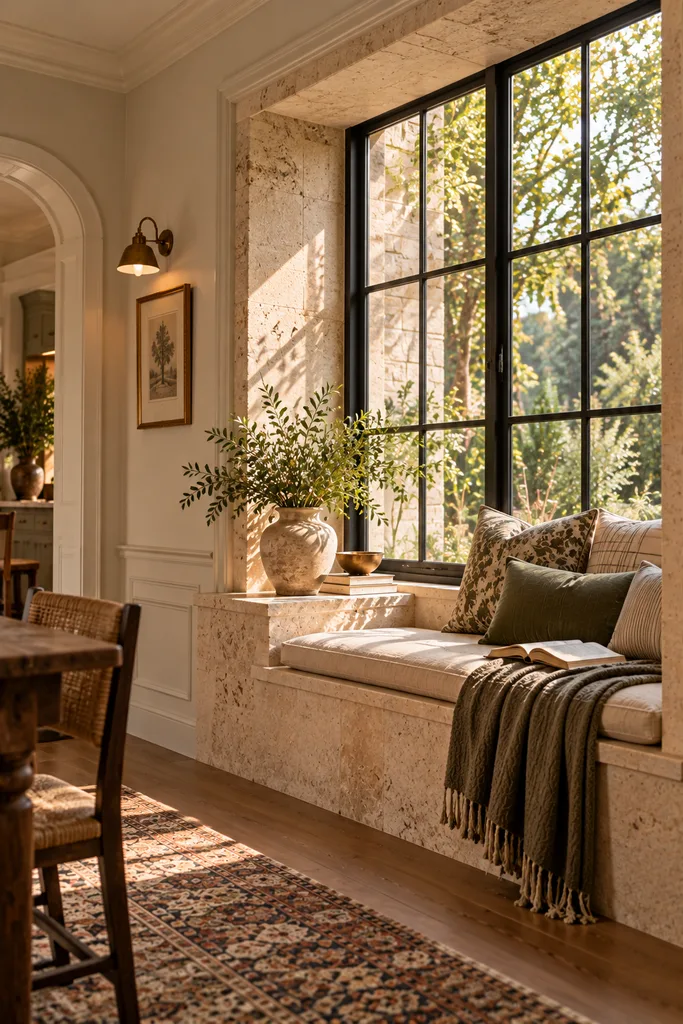
6. Bring in One Statement Stone Surface
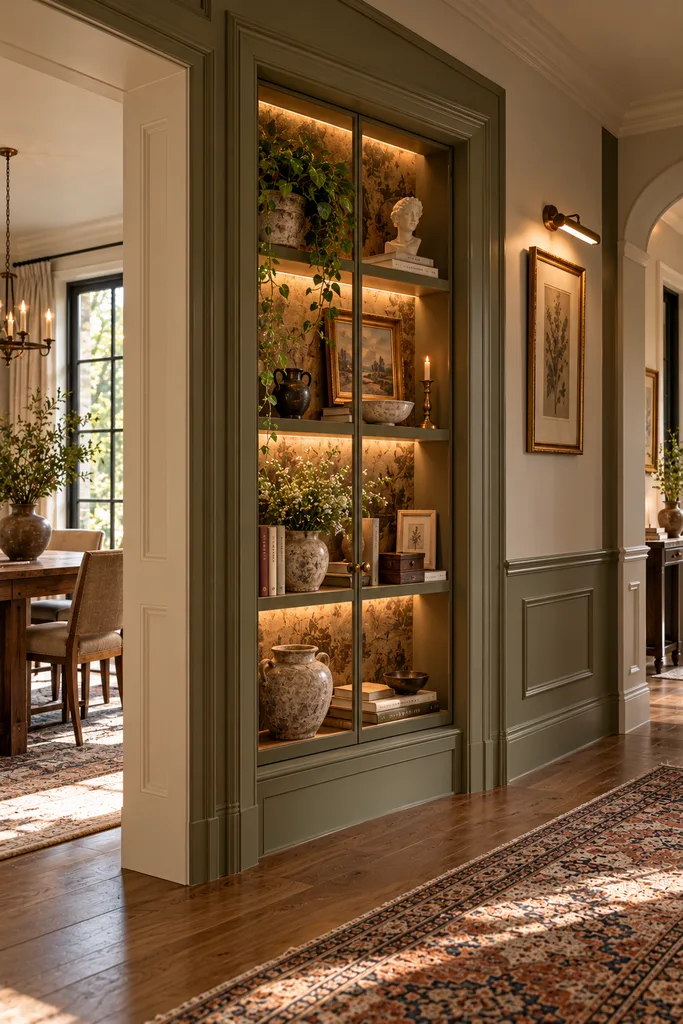
Natural-looking stone immediately adds visual weight to a room.
That doesn’t mean covering an entire house in marble.
One strong stone element can be enough: a fireplace surround, kitchen backsplash, coffee table, vanity top, or substantial side table.
I like stones with visible movement rather than perfectly uniform patterns.
Travertine, soapstone, limestone, marble, and convincing natural-looking alternatives can all work depending on the room.
The trick is letting the stone breathe. Don’t cover a beautiful surface with piles of accessories.
7. Add One Piece of Vintage Furniture
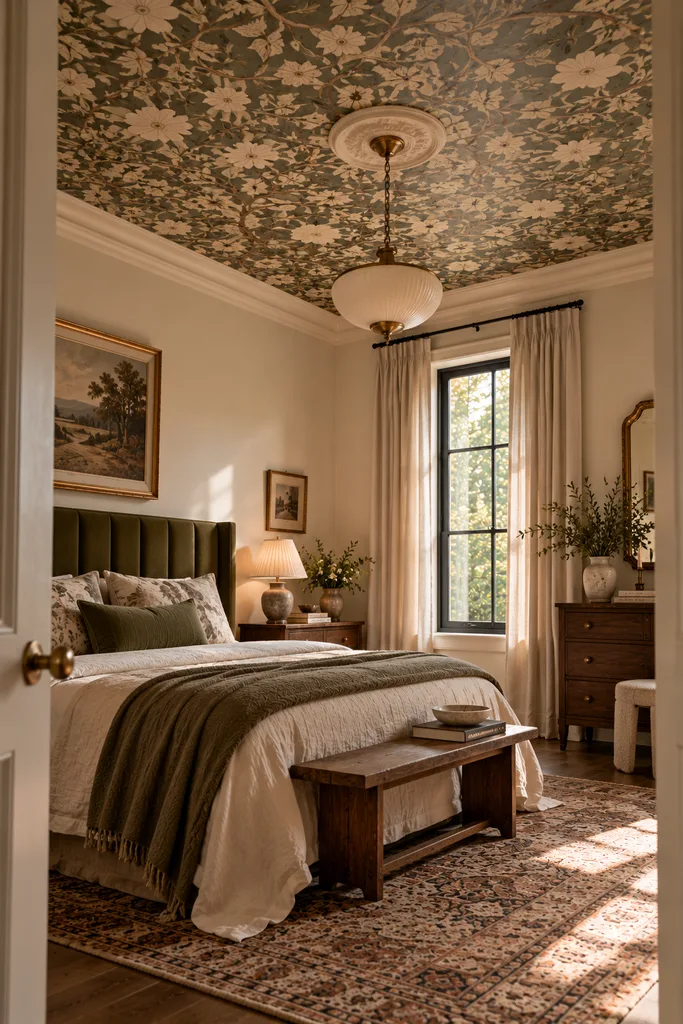
Rooms often look more expensive when everything doesn’t appear to have arrived from the same furniture delivery truck.
Bring in one older piece.
It could be an antique sideboard in the dining room, a vintage chest used as a bedside table, an old wooden cabinet in the bathroom, or a worn console in the entryway.
Scratches and variations in the wood aren’t necessarily problems.
They can make the piece feel established.
Surround it with simpler contemporary furniture and the contrast becomes much more interesting than a perfectly matched set.
8. Turn One Wall Into a Library
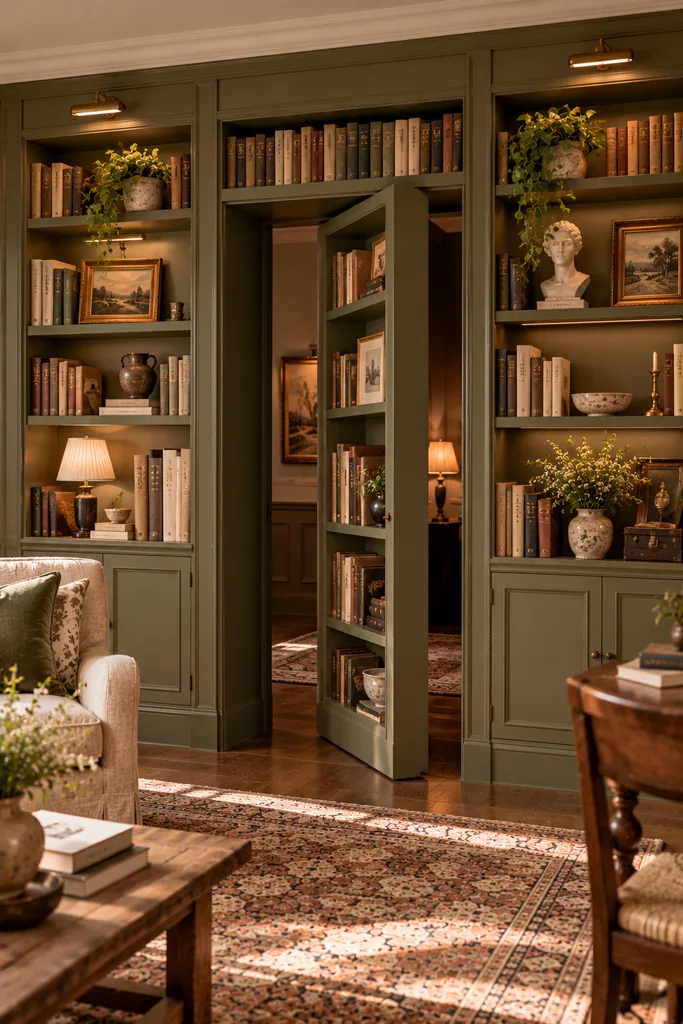
Books can add architecture as well as personality.
Instead of scattering small shelves around the house, consider dedicating one wall to books.
You can use built-ins if the budget allows, but several standard bookcases placed together can create a similar visual effect.
Paint them the same color as the wall if you want them to appear more integrated.
Then fill the shelves naturally.
Use real books, leave some gaps, and resist the temptation to put a decorative object between every five books.
A library wall should look used.
9. Hide Small Kitchen Appliances
One of the easiest ways to make a kitchen feel calmer is simply to reduce what lives permanently on the counter.
The toaster, blender, coffee supplies, air fryer, bread bags, charging cables, and other everyday items can quickly dominate a kitchen.
If possible, create an appliance cabinet or use an existing deep cabinet for frequently used machines.
You don’t have to hide absolutely everything.
Keep out the things you genuinely use several times a day.
But clearing even half the visual clutter can allow the countertops, backsplash, cabinetry, and lighting to become much more noticeable.
10. Use Limewash or Softly Textured Walls
Perfectly flat paint isn’t the only option.
Limewash and other subtle mineral-style finishes create natural tonal variation across a wall.
That variation becomes especially beautiful as daylight changes.
I like it in bedrooms, dining rooms, hallways, and quiet living spaces where you can actually notice the texture.
Choose earthy colors rather than making the finish overly dramatic—warm stone, dusty taupe, muted clay, soft olive, or chalky off-white.
The slight imperfection is exactly what makes the wall interesting.
11. Lean an Oversized Mirror Against the Wall
A large mirror can completely change a room because it reflects both light and architecture.
Instead of hanging several small mirrors, try one oversized floor mirror.
Lean it securely against a bedroom, dressing-room, hallway, or living-room wall.
A thin dark frame feels more contemporary, while aged wood or antique brass can make it feel collected.
Position it where the reflection is attractive.
A mirror reflecting a window, artwork, or doorway adds much more than one reflecting a pile of storage boxes.
And of course, secure large leaning mirrors appropriately, especially around children or pets.
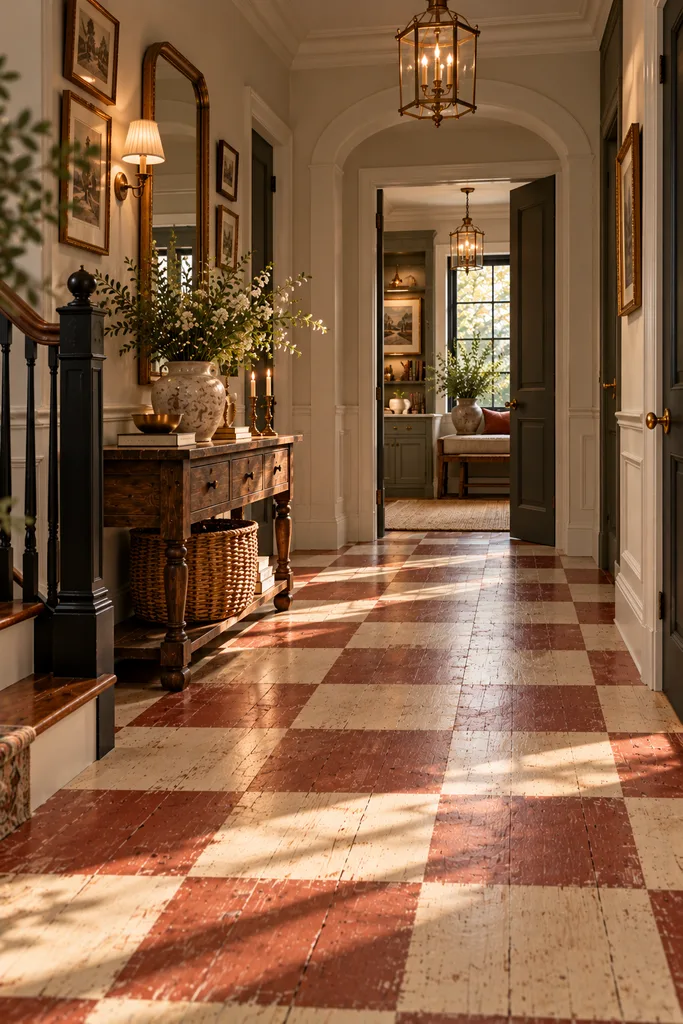
12. Use Checkerboard Flooring Somewhere Unexpected
Checkerboard flooring doesn’t have to mean a grand black-and-white marble foyer.
A softer version can look much more relaxed.
Try warm white and limestone, cream and terracotta, or muted gray and off-white.
I especially like checkerboard floors in small entries, laundry rooms, mudrooms, kitchens, or powder rooms.
Because the pattern itself has personality, you can keep the rest of the space simple.
A small room is also a practical place to experiment with a stronger flooring idea without committing to it throughout the house.
13. Replace Generic Hardware With Aged Metal
Tiny hardware changes can make surprisingly noticeable differences.
Cabinet knobs, drawer pulls, door handles, hooks, and even switch plates are things you touch and see constantly.
Aged brass, antique bronze, darkened nickel, or simple black hardware can give ordinary cabinetry more character.
I wouldn’t mix five finishes in one small room.
Choose one dominant finish and allow it to repeat quietly.
The goal isn’t for someone to walk in and immediately notice the handles. It’s for the room as a whole to feel more considered.
14. Use Upholstered Dining Chairs
Dining rooms contain a lot of hard surfaces—tabletop, flooring, cabinetry, glassware, and sometimes bare walls.
Upholstered chairs soften all of that.
You don’t necessarily need eight large upholstered chairs.
Try using them only at the two ends of a rectangular table while keeping simpler wooden chairs along the sides.
That little change creates hierarchy and makes the dining setup feel collected rather than purchased as one matching set.
Choose durable fabric in oatmeal, muted stripe, tobacco, olive, or another forgiving shade if the chairs will be used every day.
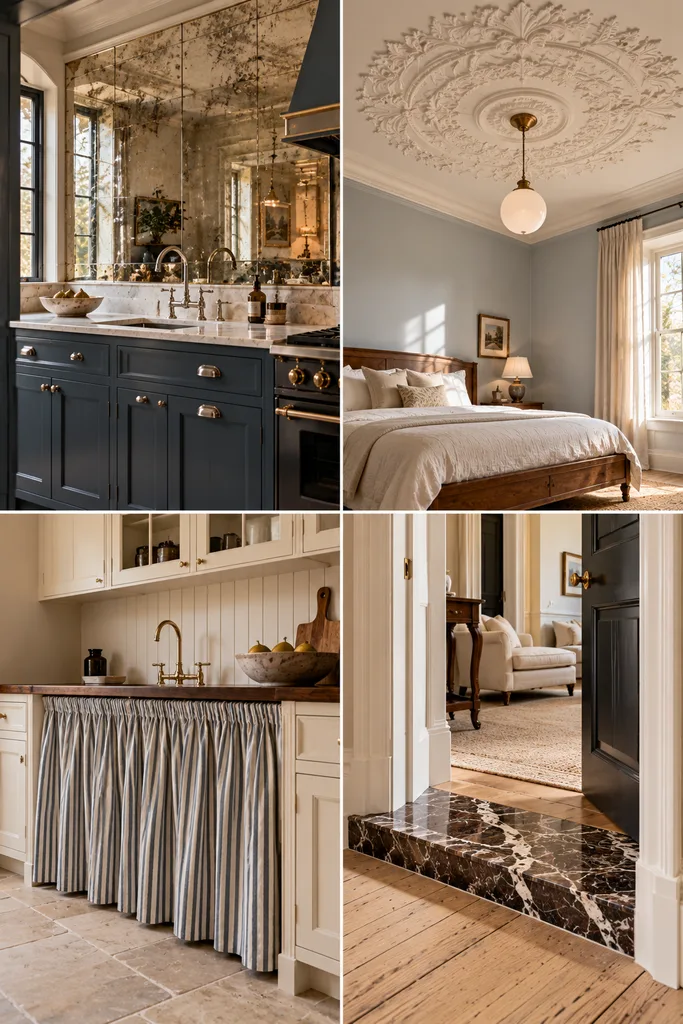
15. Make the Entryway Dramatic
The entryway gives you permission to do something stronger than you might choose for the entire house.
Try deep wall color, patterned flooring, an oversized pendant, a substantial mirror, or a beautiful old console.
You don’t need all of them at once.
Choose one or two strong features and let them dominate.
Because people pass through an entry rather than spending hours there, richer colors and stronger patterns can feel exciting instead of overwhelming.
Even a narrow entry can have presence.
16. Paint Interior Doors a Darker Color
White doors are perfectly fine, but they aren’t your only option.
Painting an interior door charcoal, olive, deep brown, dusty blue, or muted burgundy can turn a basic architectural element into part of the decor.
This works particularly well when the surrounding walls are lighter.
You can paint one special door—perhaps a pantry or home office—or repeat the color throughout a hallway for consistency.
Add simple black or aged-brass hardware and suddenly a builder-basic door feels much more intentional.
17. Layer One Smaller Rug Over a Larger Rug
Layered rugs can solve both practical and visual problems.
Start with a large simple rug—jute, sisal, wool, or another quiet neutral—that properly anchors the furniture.
Then place a smaller vintage or patterned rug over part of it.
This lets you use an interesting rug that might otherwise be too small for the room.
I especially like this in bedrooms and living rooms where the larger rug provides scale while the smaller rug contributes color and character.
Keep the rest of the textiles restrained so the floor doesn’t become too busy.
18. Try a Skirted Table
Skirted tables have started appearing again in interiors, and I understand why.
Fabric introduces softness where you’d normally see another hard piece of furniture.
A round skirted table can work beautifully as an entry table, bedside table, living-room side table, or small dining table.
The fabric doesn’t need to be fussy.
Plain linen, a subtle stripe, or a small check can keep it relaxed.
It can also hide practical storage underneath, which makes this one of the rare decorating ideas that’s both beautiful and useful.
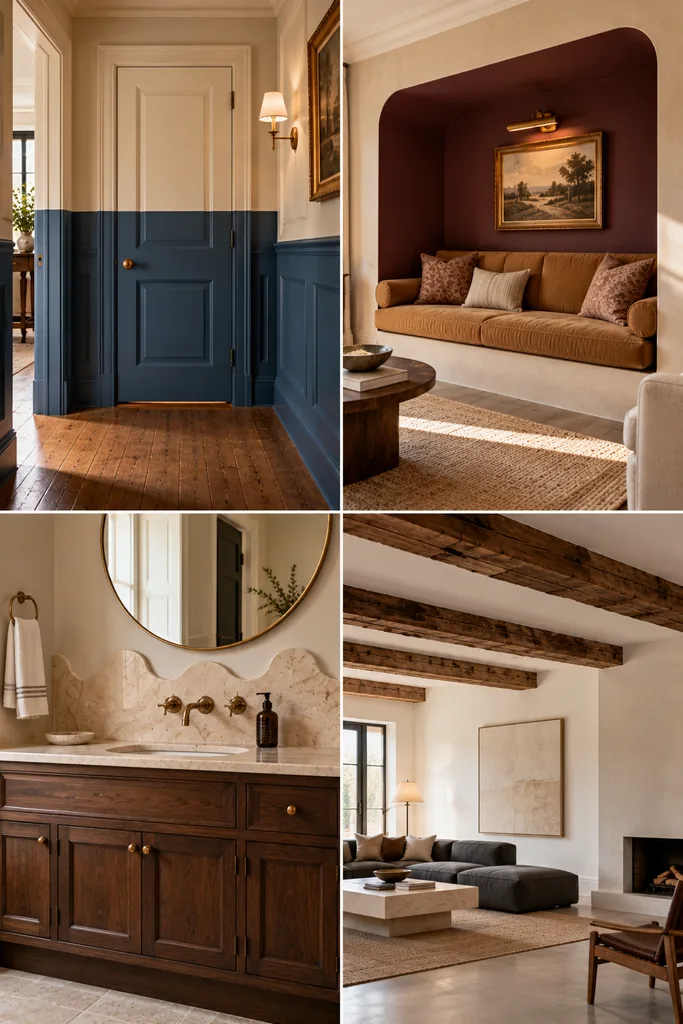
19. Create a Wall-to-Wall Headboard
Instead of treating the headboard as a piece of furniture exactly the width of the mattress, expand it.
A wide upholstered headboard running behind the bed and bedside tables can make an ordinary bedroom feel custom.
You could use linen, velvet, textured fabric, wood paneling, or even a simple padded wall treatment.
Keep the bedding quieter if the headboard is substantial.
The width is what creates the impact.
It visually anchors the entire sleeping area and can make even a fairly simple bed frame feel much more considered.
20. Paint Built-In Shelves the Same Color as the Wall
Built-ins don’t always need to be white.
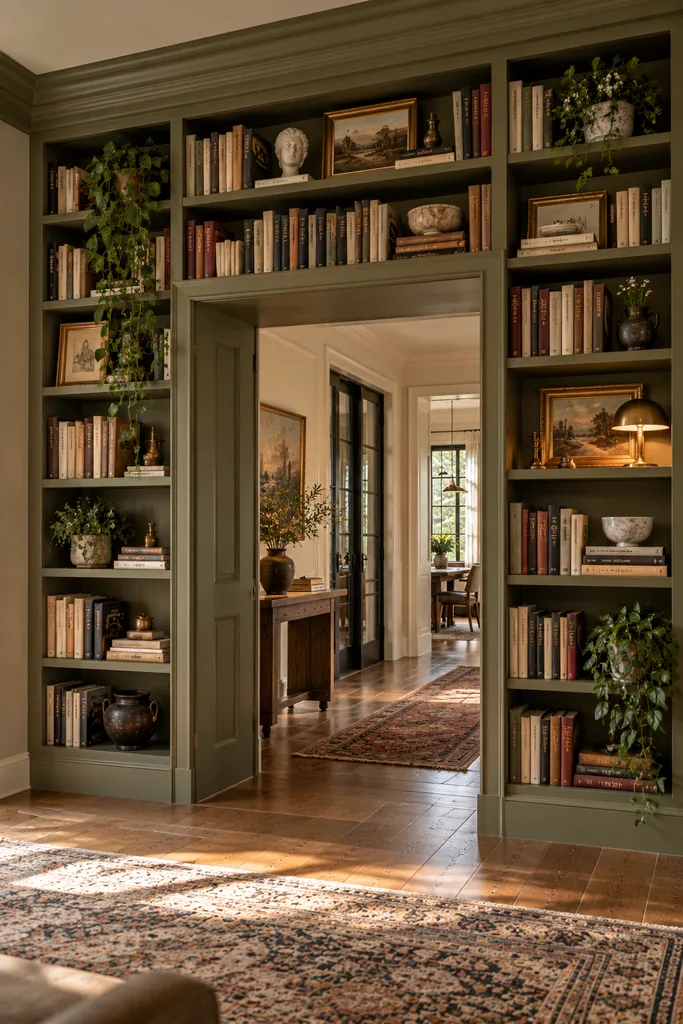
Painting shelving, surrounding walls, trim, and sometimes even the ceiling in one related color can make inexpensive cabinetry feel much more integrated.
Muted olive, smoky blue, mushroom, clay, and deep brown all work beautifully.
Then let the objects on the shelves provide contrast.
Books, framed photographs, and a few personal objects are enough.
Leaving some shelf space empty is important too. Expensive-looking rooms rarely appear desperate to fill every inch.
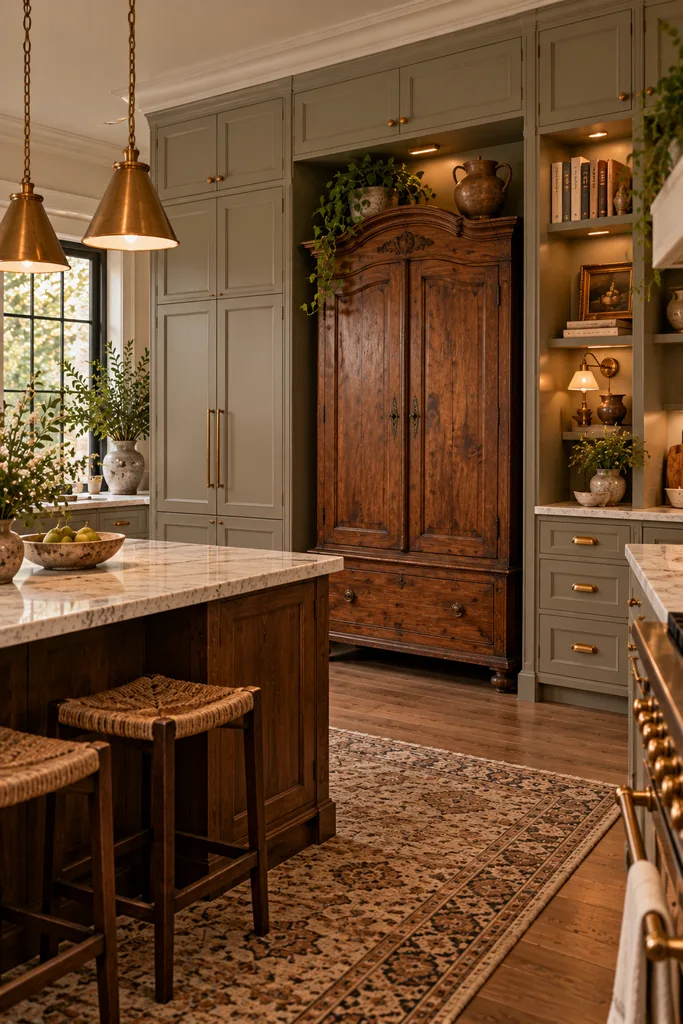
21. Make the Kitchen Island the Statement
If you’re updating a kitchen, you don’t necessarily need dramatic finishes everywhere.
Let the island do the work.
Use a different cabinet color, substantial stone top, interesting wood finish, or larger pendant lights above it.
The surrounding cabinets can remain simple.
I particularly like islands in dark walnut, muted olive, deep blue-gray, or clay against lighter kitchens.
Because the island sits in the middle of the room, it naturally becomes a focal point without requiring lots of decorative styling.
22. Give the Ceiling Architectural Detail
Paint isn’t the only way to improve a ceiling.
Depending on the house, you could add simple beams, restrained paneling, shallow coffering, tongue-and-groove boards, or a ceiling medallion around an existing light fixture.
The detail should make sense with the architecture.
A small modern apartment probably doesn’t need enormous fake rustic beams.
But subtle ceiling treatment in the right room can make the entire space feel more finished because people aren’t used to seeing attention given overhead.
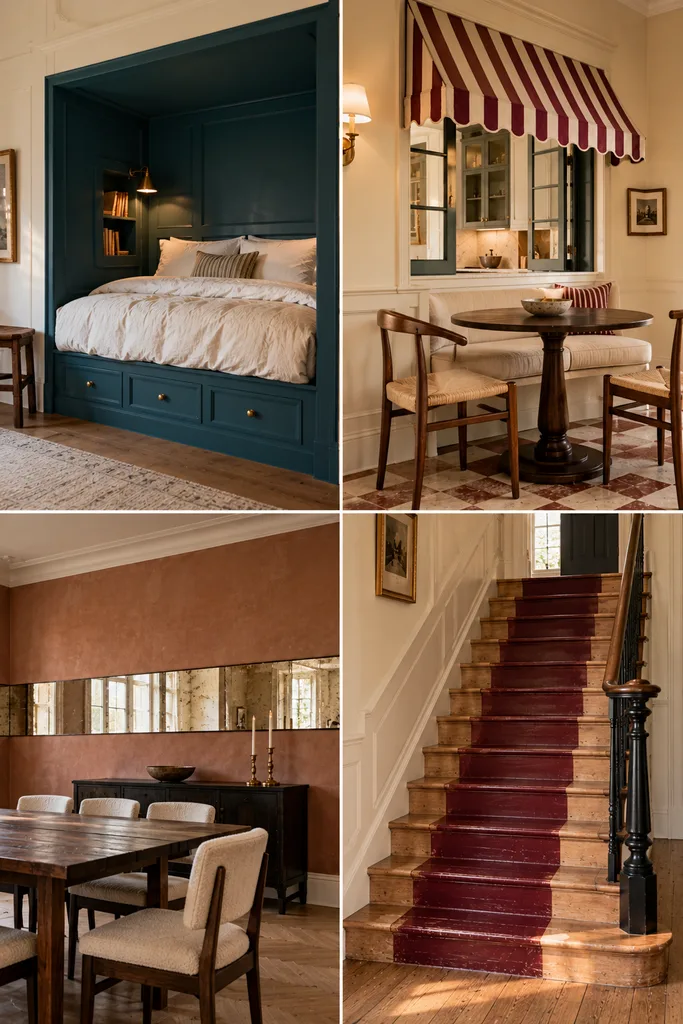
23. Use Fluted or Reeded Glass Doors
Fluted glass is useful because it allows light to move between spaces while slightly obscuring what’s behind it.
Try it on a pantry door, cabinet fronts, bathroom door, office partition, or built-in storage.
Paired with dark metal or natural wood frames, it creates texture without adding another color or pattern.
I particularly like it in kitchens because it can break up a large run of solid cabinetry.
Unlike completely clear glass, it also doesn’t require everything behind the door to be perfectly arranged.
24. Display a Small Collection of Handmade Ceramics
Collections can make a home feel personal, but quantity matters.
Rather than scattering decorative objects throughout every room, group a small collection in one place.
A few handmade ceramic bowls, pitchers, or vessels displayed on an open shelf or old cabinet can have much more impact together.
Let the shapes, glazes, and slight imperfections vary.
And don’t fill every available space.
The collection should feel like something accumulated because you genuinely like it, not something purchased as a matching decor set.
25. Replace a Forgettable Light With an Architectural Fixture
Lighting is one of the fastest ways to change how a room feels.
Look at the fixture itself before worrying about decorative accessories.
A sculptural pendant above the dining table, oversized lantern in an entryway, long linear fixture above a kitchen island, or simple plaster pendant in a bedroom can become part of the architecture.
Scale matters here.
A tiny light floating in a large room can make the entire space feel less resolved.
I’d rather choose one appropriately sized fixture and keep the surrounding decor quieter.
Final Thoughts
If I wanted my home to look more expensive, I wouldn’t begin by buying more accessories.
I’d first look at the things that visually define the room: walls, ceilings, windows, doors, floors, lighting, large furniture, and scale.
Those are the elements your eye notices before the small objects sitting on a coffee table.
I’d also avoid doing all 25 ideas in the same house.
Choose the changes that make sense for your architecture.
Maybe your living room only needs higher curtains and one properly scaled piece of artwork. Perhaps the dining room would benefit from picture-frame molding. Your hallway might completely change with darker doors, while the kitchen may simply need clearer counters and a stronger island.
And don’t underestimate older furniture or imperfect materials.
A scratched vintage cabinet, softly faded rug, irregular limewashed wall, natural stone surface, or handmade ceramic can often add more character than something perfectly new.
The goal isn’t to make your house look like an expensive hotel.
It’s to make it look like someone thought carefully about the space.
When the scale is right, materials feel genuine, architecture has some interest, and unnecessary clutter is removed, even a fairly modest home can feel significantly more polished.