
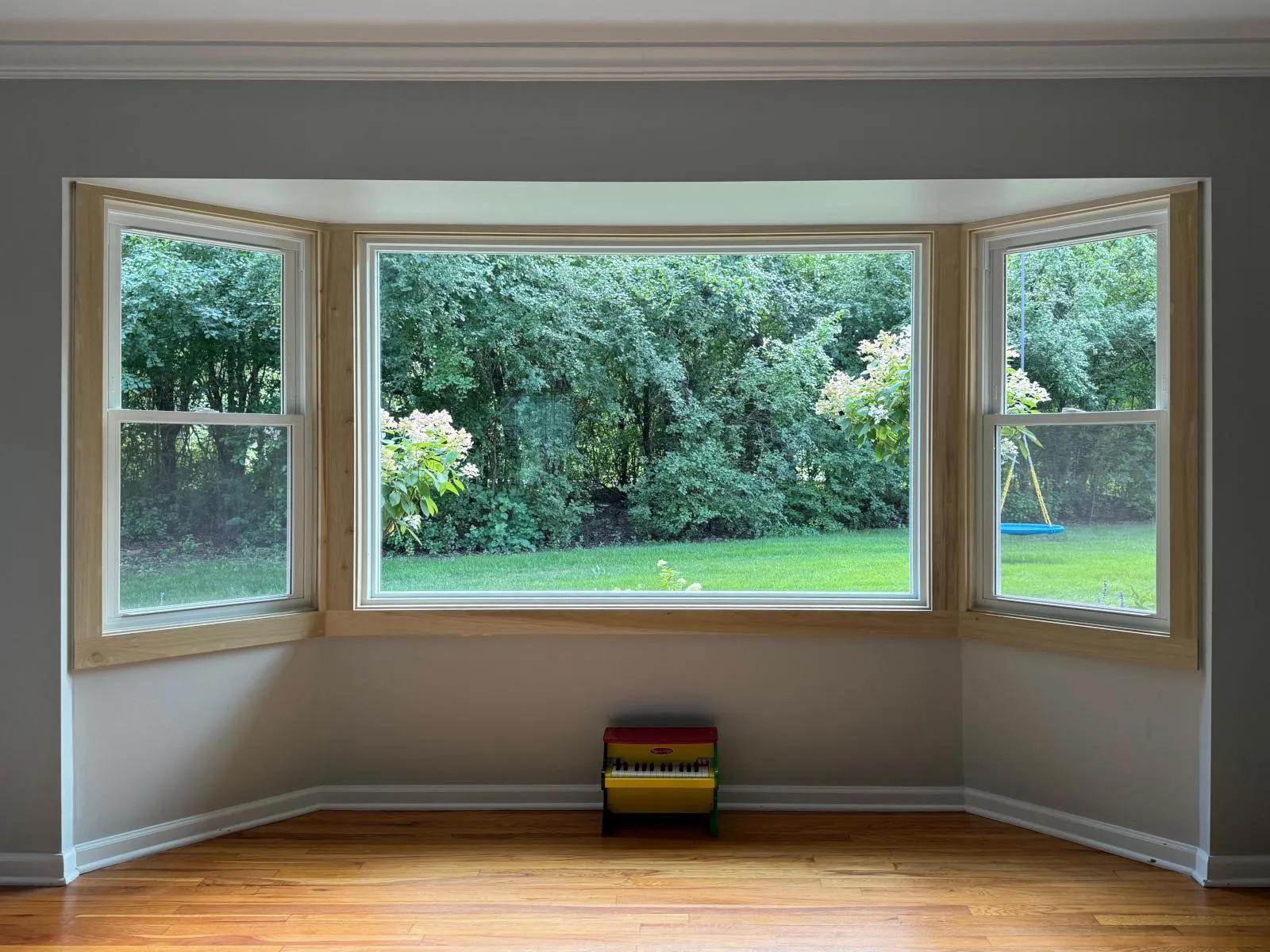
The Architectural Hack That Defined a City
Most homeowners look at a bay window and see a nice spot for houseplants. When we evaluate properties across Chicagoland, we see something else entirely. We see a structural focal point that either bleeds money in heating bills or acts as the highest-ROI upgrade you can put on a Midwest home.
People assume projecting bay windows are just a stylistic choice. They aren’t.
Back in the late 19th century, the “Chicago Window” was engineered out of pure necessity. Before the luxury of modern HVAC systems and cheap electricity, architects had a massive problem: how do you get natural light and airflow into deep, cavernous commercial buildings?
The solution was a massive fixed central pane flanked by two narrow, operable double-hung sashes. You can still see the DNA of this design in the Reliance Building (1895) and Louis Sullivan’s masterpiece, the Sullivan Center (1899). They pushed the glass out. They built projecting bays to catch the breeze off Lake Michigan and funnel daylight into the interiors.
It wasn’t aesthetics. It was a 19th-century engineering hack.

The Residential Reality: Greystones to Bungalows
That commercial innovation quickly trickled down to residential blocks. If you walk through any historic Chicago neighborhood today, you’ll notice a pattern.
- The 2/3-Flats and Greystones: Built tight against neighboring property lines, these homes are notoriously dark in the middle. Three-sided projecting bays were bolted onto the front facades to literally steal sunlight from multiple angles.
- The Classic Chicago Bungalow: These usually feature projecting front window blocks explicitly designed for built-in window seats.
Light isn’t a luxury during a long, gray Illinois winter—it affects your mood, your heating load, and the perceived square footage of a room. A bay window physically extends your footprint without pouring a new foundation.
But here is where things go wrong.
The Brutal Truth About Aging Bays
Because they project outward, bay windows take a beating. They are exposed to wind, snow, and ice on three sides, plus the roof and the base.
We typically see three major failure points when we tear out old units:
- Sagging: The structural support fails, and the window starts to bow under its own weight.
- Base Rot: Water infiltrates the bottom seat board. By the time you notice the paint peeling inside, the exterior wood is usually pulp.
- Drafts: Old, compressed weatherstripping turns your beautiful reading nook into a freezing wind tunnel.
This is why patching an 80-year-old wooden bay is usually a losing battle. You need modern thermal defense. Whether we are installing custom Marvin fiberglass units, high-end Andersen wood composites, or premium vinyl from Advanced Window Corp, the goal is identical: stop thermal transfer.
We often recommend aluminum capping for the exterior trim. It seals the wood permanently. No more scraping. No more rot.

Red Tape: Don’t Mess With Chicago Building Codes
You cannot just bolt a massive window to the front of your house in Cook County and hope for the best.
If your property sits tight to the sidewalk, you are dealing with city airspace. Chicago building codes are rigid about this. If your bay window projects over the public way, you are legally required to obtain a Public Way Use Permit from the Department of Business Affairs and Consumer Protection.
And there are hard limits.
Generally, you can’t have a structure protruding over a public sidewalk if it’s less than 12 feet above ground level.
Then there is the child safety factor. Under modern codes, if the bottom sill of an operable window in a residential home sits lower than 36 inches from the floor, you will likely need specialized opening restrictors (ASTM F2090 compliance) to prevent falls.
(Your average contractor won’t tell you this until the inspector flags it. We handle it before the glass is even ordered).
Why Warmdreams? (The Operational Reality)
We don’t just sell windows. We engineer exterior envelopes.
When you read through our 500+ reviews—noticing homeowners explicitly naming our project managers like Igor and Yuri—it’s because we treat the installation as the product. You can buy a $5,000 Pella or ProVia window, but if the flashing is taped wrong and the gaps aren’t insulated properly, it will leak just like a builder-grade special.
Our crews operate differently:
- We show up when promised (often earlier than the projected timeline).
- We lay down drop cloths and respect your interior.
- We handle the heavy lifting, from the permits to the final exterior caulking.
A bay window isn’t just a wall with glass in it. It’s a complex, multi-angled structure that demands absolute precision. Do it wrong, and you’ll feel the Chicago wind in your living room. Do it right, and you completely transform how your house feels, looks, and holds its value.