
What is RYB color model or Color Subb? RYB stands for Red, Yellow, and Blue, the three traditional primary colors used in painting and art. By mixing these colors in different combinations, artists can create a wide range of secondary and tertiary colors on the classic color wheel.
If you’ve ever blended paints in art class, you’ve worked with RYB. It’s a subtractive color model, meaning colors are created by combining pigments that absorb certain wavelengths of light. While modern design often uses RGB for screens or CMY for printing, RYB is still the foundation for mixing colors in traditional art, crafts, and education.
What is RYB Color Model?
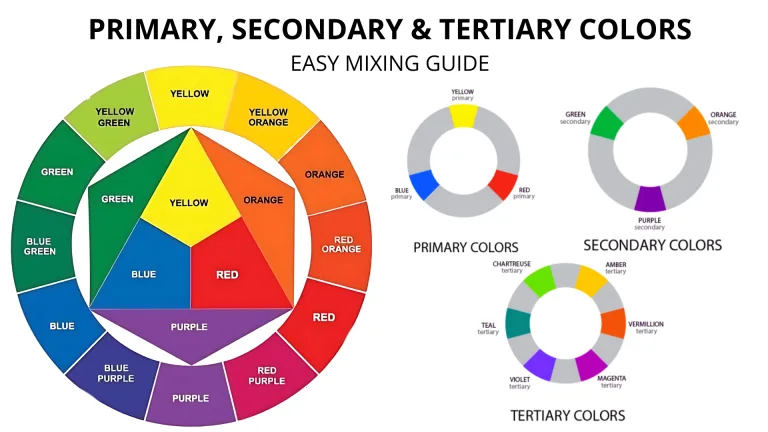
The RYB color model is a traditional subtractive color system that uses Red, Yellow, and Blue as its primary colors. It’s mainly used in painting, art, and other mediums that involve physical pigments. In this model:
- Primary colors: Red, Yellow, Blue
- Secondary colors: Orange, Green, Purple (made by mixing two primaries)
- Tertiary colors: Created by mixing a primary with a neighboring secondary
RYB works by subtracting light—pigments absorb certain wavelengths and reflect others. It’s been used for centuries in art education because it’s intuitive, visually simple, and easy for artists to apply when mixing paints.

How RYB Works
RYB is a subtractive color model—meaning it starts with light bouncing off a white surface and removes (or subtracts) certain wavelengths when pigments are added.
- The primary colors in RYB are Red, Yellow, and Blue.
- Mixing two primaries creates secondary colors:
Red + Yellow = Orange
Yellow + Blue = Green
Blue + Red = Purple
- Mixing all three primaries in roughly equal parts produces a muted, brownish color because so many wavelengths are absorbed.
Unlike RGB, which is based on light, RYB is about physical media—paint, ink, pastels, or dyes—where pigments control the colors we see.

Where RYB Is Used
RYB is still the go-to model for many creative fields:
- Painting & Fine Arts — Acrylics, oils, and watercolors follow RYB mixing rules.
- Crafts & DIY — From fabric dyes to handmade cards, RYB guides color combinations.
- Education — Schools teach RYB in early art classes because it’s simple and easy to visualize.
- Traditional Design — Interior decorators and muralists often start with RYB-based palettes for harmonious schemes.

RYB vs. RGB and CMY
It’s easy to confuse RYB with RGB , CMYK , CMY (Cyan, Magenta, Yellow), but the systems are designed for different purposes:
| RYB | RGB | CMY/CMYK |
|---|---|---|
| For physical pigments | For light-based media | For printing inks |
| Red, Yellow, Blue primaries | Red, Green, Blue primaries | Cyan, Magenta, Yellow (+ Black) primaries |
| Secondary colors: Orange, Green, Purple | Secondary colors: Cyan, Magenta, Yellow | Secondary colors: Red, Green, Blue |
| Subtractive mixing | Additive mixing | Subtractive mixing |
RYB is great for teaching and working with paint, but for high-precision color reproduction (like printing), CMY offers more accurate mixing.
The RYB Color Wheel
The traditional RYB color wheel is split into:
- Primary Colors — Red, Yellow, Blue
- Secondary Colors — Orange, Green, Purple
- Tertiary Colors — Red-Orange, Yellow-Orange, Yellow-Green, Blue-Green, Blue-Purple, Red-Purple
Artists use this wheel to find complementary colors (opposites on the wheel), analogous colors (neighbors), and triadic palettes for balance and contrast.

How to Mix Colors Using RYB
In painting, the results depend heavily on pigment quality, brand, and even the paper or canvas.
- To make a bright secondary color, use clean, pure primary pigments (like cadmium yellow, ultramarine blue, or cadmium red).
- To make a muted tone, mix complements (e.g., red + green for a warm brown).
- For lighter tints, add white; for darker shades, add black or a deep complementary color instead.
Why RYB Still Matters
Even though CMY is more technically accurate for pigment science, RYB is still deeply ingrained in art culture. It’s intuitive, easy to teach, and visually appealing in educational settings. Most traditional painters still think in RYB terms when they mix on a palette.
Conclusion
RYB is the bridge between color theory and hands-on creativity. Whether you’re blending acrylics for a landscape, experimenting with watercolors, or teaching kids about color for the first time, RYB offers a simple, time-tested framework for making beautiful combinations.
Understanding RYB also makes it easier to transition into more technical systems like CMY or digital RGB—because at the end of the day, color theory is all about relationships, and RYB is one of the clearest ways to see them.
FAQs
What does RYB stand for?
RYB stands for Red, Yellow, and Blue, which are considered the primary colors in traditional art and painting. They form the basis for mixing all other colors on the classic artist’s color wheel.
Is RYB the same as RGB?
No. RYB is used for physical pigments like paints and dyes, while RGB is used for light-based displays like TVs, monitors, and phones. They follow different mixing rules—RYB is subtractive, RGB is additive.
Why is RYB called a subtractive color model?
In RYB, pigments absorb (subtract) certain wavelengths of light and reflect others. When you mix colors, more wavelengths are absorbed, which is why mixing many pigments together often results in darker, muted tones.
What are the secondary colors in RYB?
Mixing two primaries in RYB gives you:
Red + Yellow = Orange
Yellow + Blue = Green
Blue + Red = Purple
Can RYB make all colors?
RYB can make a wide range of colors, but not every shade is possible—especially very bright cyan or magenta tones. That’s one reason modern printing uses CMY instead of RYB for greater accuracy.
Why do artists still use RYB instead of CMY?
RYB is simpler to teach, easy to visualize, and has been used for centuries. Many artists also find it more intuitive when mixing paints by hand.
What is the difference between primary, secondary, and tertiary colors in RYB?
Primary colors are the base colors—Red, Yellow, Blue.
Secondary colors are made by mixing two primaries—Orange, Green, Purple.
Tertiary colors are made by mixing a primary with a neighboring secondary—such as Yellow-Orange or Blue-Green.