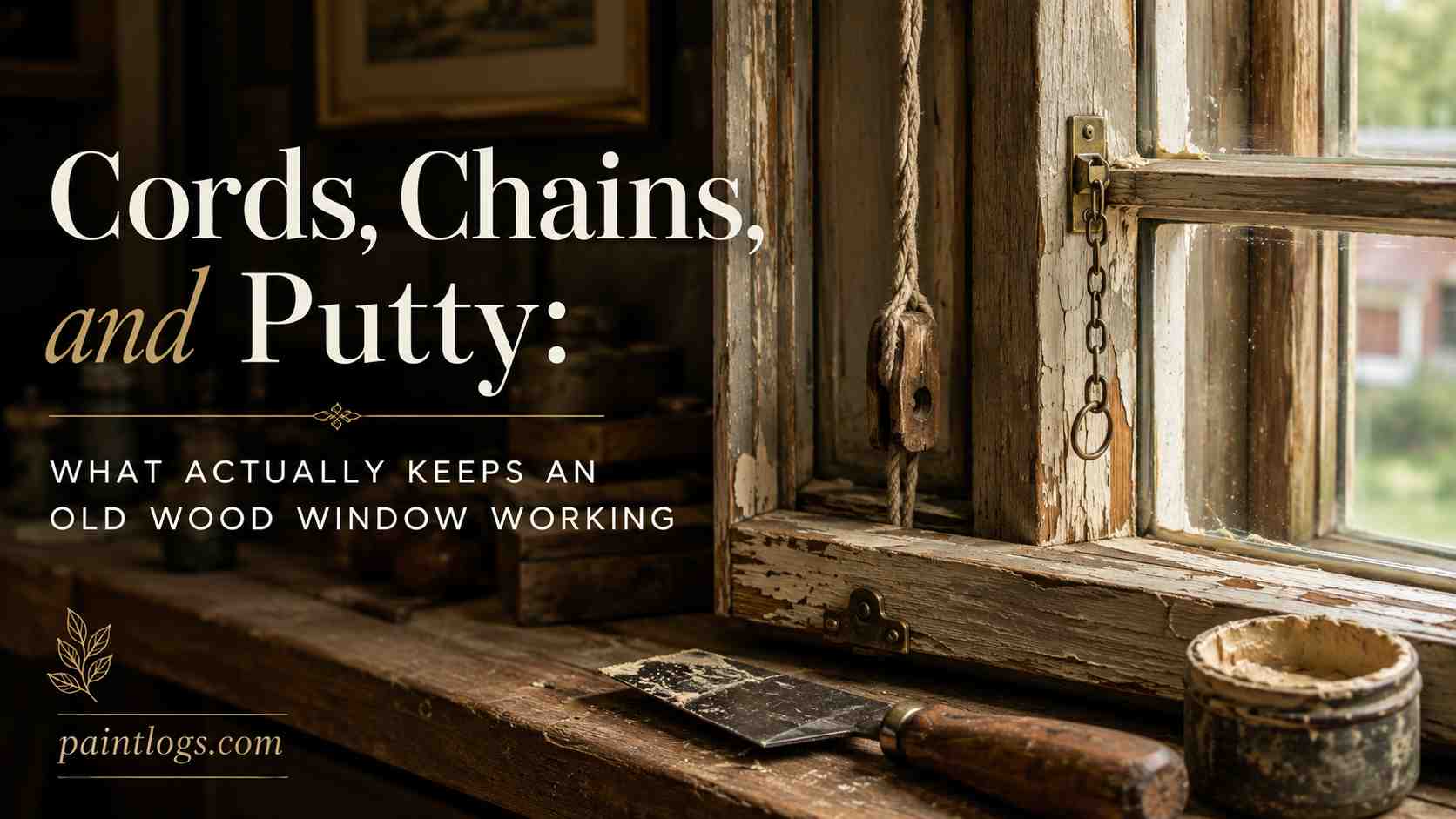
Cords, Chains, and Putty: What Actually Keeps an Old Wood Window Working
A window that will not stay open, a pane that rattles in the wind, a draft you can feel from across the room. In a house built before the war, these are not three separate problems. They are three parts of the same window wearing out on their own schedule, and every one of them is a repair, not a reason to replace the window.
The parts that fail, in the order they fail
An old double hung window is a machine. Wood holds the glass, putty seals it, rope and iron move it. Each of those has a service life, and none of them is the wood itself.
- Glazing putty goes first. It hardens, cracks, and falls out in pieces, usually on the south and west sides of the house where the sun hits hardest. Typical life is twenty to thirty years.
- Sash cords go next. Cotton rope frays where it runs over the pulley, then parts under load. This is why a window suddenly will not stay up.
- Paint fails last but does the most damage, because once the film breaks, water gets into the joints and rot starts.
The wood, meanwhile, is usually fine. Old growth pine and cypress from a hundred years ago is denser and more rot resistant than the softwood in most new units. That is the whole argument for repair: the expensive part of the window is the part that lasted.
Sash cords and chains
Behind the side casing of a double hung window is a hollow pocket with a cast iron weight in it. The weight hangs on a cord that runs up over a pulley and ties into the side of the sash. Balanced correctly, the sash weighs almost nothing in your hand and stops wherever you let go of it.
When the cord breaks, the weight drops into the pocket and the sash gets heavy and crooked. People prop these windows with books and paint cans for years. It is worth knowing that a falling sash is a real hazard with small children in the house.
The repair is straightforward for someone who has done it: remove the stop, take the sash out, open the pocket, retrieve the weight, run new cord, set the length so the sash balances, put the trim back without splitting it. Two decisions come up.
- Cotton cord is the original material and the right call on a window that gets opened a few times a season, or where a preservation commission is involved.
- Bronze or stainless chain costs more and lasts far longer. On a bedroom window that gets opened every day in summer, chain is the better answer.
One habit worth adopting: replace both cords on a sash, not just the broken one. The second rope is the same age as the one that just failed, and the labor is in getting the sash out, not in the rope.
Reglazing is maintenance, not restoration
Reglazing means removing the old hardened putty, cleaning the rabbet, re-bedding the glass, setting new glazing points, and running a fresh putty bevel. It is the single most neglected piece of wood window maintenance, and the one with the largest payoff.
Failed putty does three things at once. It lets the pane rattle, which eventually cracks it. It lets water sit against the muntin and rail, which starts rot exactly where repairs are most expensive. And it opens an air path around every pane, which is where much of the draft in an old house actually comes from, not through the glass.
The National Park Service treats this as basic upkeep rather than specialty work. Its Preservation Brief on wood windows walks through the same sequence any competent shop follows and is worth reading before you get quotes (https://www.nps.gov/orgs/1739/upload/preservation-brief-09-wood-windows.pdf).
What good reglazing looks like
If you are watching the work or checking it afterward, this is the sequence:
- Old putty is softened and removed without scorching the wood or breaking the glass.
- The rabbet is cleaned to bare wood and primed with oil primer. Skipping this is the most common shortcut, and it is why some putty jobs fail in three years instead of thirty.
- Glass is bedded in a thin layer of putty so it sits on a cushion, not on bare wood.
- Glazing points hold the pane mechanically. Putty is a seal, not an adhesive.
- The bevel is run in one pass and left to skin over before painting.
- Paint laps two millimeters onto the glass. That overlap is what keeps water out of the putty line, and it is deliberate, not sloppy cutting in.
Winter and deep summer both work against fresh putty, so this is spring and fall work in New England.
When repair stops making sense
Repair is not always the answer. If the sash rails are soft enough to push a screwdriver into, if the joints have opened and the corners move, if a previous owner has already ripped out the weight pockets to fit a vinyl insert, the case for saving that particular sash gets thin.
Everything short of that is repairable, and the work is specialized enough that experience matters more than equipment. In neighborhoods like Jamaica Plain, Brookline, and Newton, where most of the housing stock predates 1940, shops that do wood window restoration in Boston handle cords, putty, and rot on the same visit, because on a window that age it is rarely just one of the three.
Ask any contractor a few questions before hiring: do you re-rope both sides of a sash, do you prime the rabbet before bedding glass, and do you take the sash out or try to glaze it in place. The answers tell you quickly whether you are talking to someone who repairs windows or someone who sells replacements.
The bottom line
The expensive part of an old wood window is the wood, and it is usually the part still in good shape. Cords, chains, and putty are wear items, priced accordingly, and replacing them costs a fraction of a full window replacement. A window that has already lasted a century will outlast any unit you can buy today, as long as somebody keeps up with the parts that were always meant to be replaced.