
When learning about color, one of the first things you’ll come across is the idea of primary, secondary, and tertiary colors. These groups form the foundation of the color wheel, which artists, designers, and even teachers use to understand how colors relate to one another.
- Primary colors are the base—you can’t create them by mixing other paints.
- Secondary colors are made when you mix two primaries.
- Tertiary colors are a blend of a primary and a secondary, giving you more variety.
Understanding these three categories makes it easier to:
- Mix paint without making muddy results.
- Choose colors that look good together.
- Apply the right palette in art, design, or even home decoration.
In this guide, we’ll break everything down with examples, diagrams, and a simple activity you can try yourself.
Quick Answer
Six mixes of a primary and its neighboring secondary:
The Color Wheel Basics
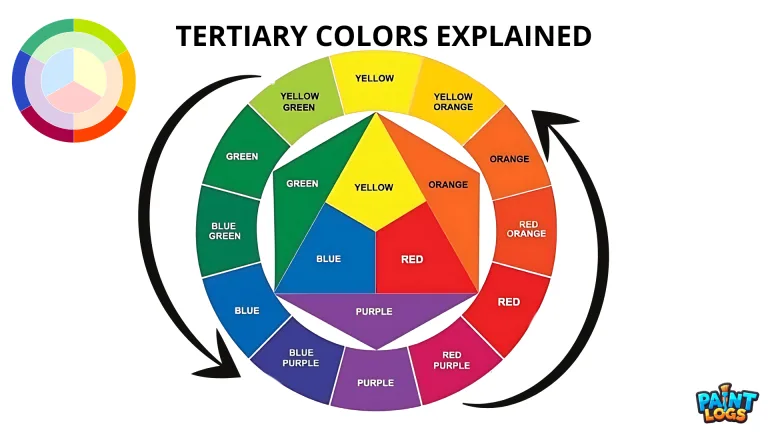
The color wheel is a simple diagram that shows how colors relate to each other. It’s usually arranged in a circle so you can see how primaries, secondaries, and tertiaries are connected.
- At the center of every wheel are the primary colors: red, yellow, and blue.
- Between them sit the secondary colors: orange, green, and purple.
- Filling the gaps are the tertiary colors, such as yellow-green or red-orange.
Different color models use slightly different wheels:
- RYB (Red, Yellow, Blue) – the traditional artist’s wheel for paint and pigment.
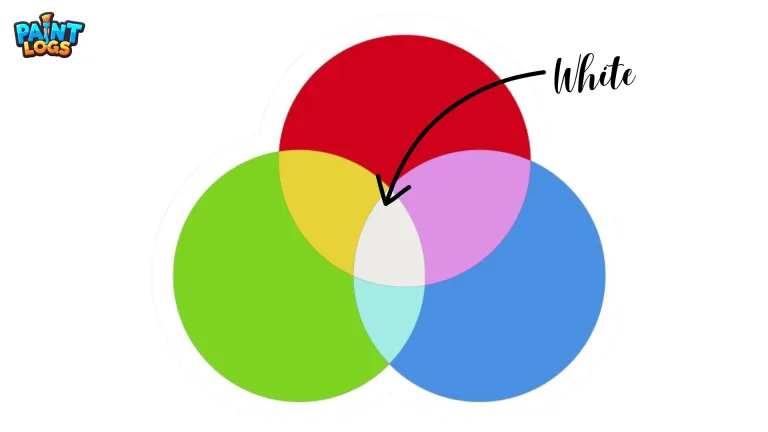
- RGB (Red, Green, Blue) – used for screens and digital displays.
- CMYK (Cyan, Magenta, Yellow, Black) – used for printers and inks.
For painting and traditional art, the RYB wheel is most common.
For digital design, you’ll work with RGB.
For print, CMYK is essential.
This basic structure helps you quickly figure out what happens when you mix two colors or when you want to build a color scheme.
Primary Colors
Primary colors are the foundation of all other colors. You cannot create them by mixing other paints.
- Red – warm, bold, and powerful.
- Yellow – bright, cheerful, and energetic.
- Blue – calm, cool, and stable.
These three make up the RYB model (Red, Yellow, Blue), which is used in painting and traditional art.
Other models have different primaries:
- RGB (screens) → Red, Green, Blue.
- CMYK (printing) → Cyan, Magenta, Yellow, Black.
- For artists mixing paint, the RYB primaries are the most useful to remember.
Secondary Colors
Secondary colors are made by mixing two primary colors together:
- Orange = Red + Yellow
- Green = Yellow + Blue
- Purple = Red + Blue
Each secondary sits between its two primaries on the color wheel.
For example:
- Mix warm red with sunny yellow, and you get vibrant orange.
- Combine cool blue with bright yellow, and you get fresh green.
- Blend deep blue with bold red, and you get rich purple.
👉 These secondaries are often the most eye-catching because they carry the energy of two primaries at once.
Tertiary Colors
Tertiary colors are created when you mix a primary with a neighboring secondary. They give you more variety and subtlety on the color wheel.
There are six tertiary colors in the traditional RYB wheel:
- Red-Orange = Red + Orange
- Yellow-Orange = Yellow + Orange
- Yellow-Green = Yellow + Green
- Blue-Green = Blue + Green
- Blue-Purple = Blue + Purple
- Red-Purple = Red + Purple
These colors often look more natural than pure primaries or secondaries. For example:
- Yellow-Green can resemble spring leaves.
- Blue-Green is close to teal or turquoise.
- Red-Orange feels like autumn leaves or fire.
Artists often use tertiaries to create realistic, balanced palettes.
Quick Reference Table
| Category | Colors | How They’re Made |
|---|---|---|
| Primary | Red, Yellow, Blue | Base colors (not mixed) |
| Secondary | Orange, Green, Purple | Mix of two primaries |
| Tertiary | Red-Orange, Yellow-Orange, Yellow-Green, Blue-Green, Blue-Purple, Red-Purple | Mix of a primary + a secondary |
Why These Categories Matter
Understanding primary, secondary, and tertiary colors makes color mixing predictable instead of guesswork.
- For Artists – You can control contrast, harmony, and avoid muddy results.
- For Designers – Knowing which colors clash or blend well helps in branding, web design, and graphics.
- For Decorators – Choosing warm vs. cool combinations can change the feel of a whole room.
- For Students & Teachers – These basics are the foundation of every color theory lesson.
In short: these categories give you the tools to mix smarter, choose better, and design with confidence.
Simple Color Mixing Activity
Want to see these color families in action? Try this quick exercise:
- Start with the three primaries — red, yellow, and blue.
- Mix them in pairs to get the secondaries: orange, green, and purple.
- Then, blend a primary with a neighboring secondary to discover tertiaries like red-orange, blue-green, or yellow-green.
- Compare how each new color feels — some will look warm and energetic, others cool and calming.
👉 This takes only a few minutes, but it shows you exactly how the color wheel.
Conclusion
Primary, secondary, and tertiary colors are the foundation of color theory.
- Primary: Red, Yellow, Blue
- Secondary: Orange, Green, Purple
- Tertiary: Red-Orange, Yellow-Orange, Yellow-Green, Blue-Green, Blue-Purple, Red-Purple
With these building blocks, you can mix almost any color you need. Whether you’re painting, designing, or decorating, this simple knowledge makes all the difference.
FAQS
What are the 3 primary colors?
In the traditional RYB model, the three primaries are red, yellow, and blue. They can’t be created by mixing other paints.
What are the 3 secondary colors?
The secondaries are orange, green, and purple. They are made by mixing two primaries together.
How many tertiary colors are there?
There are six tertiaries on the RYB wheel: red-orange, yellow-orange, yellow-green, blue-green, blue-purple, and red-purple.
Are RGB and RYB the same?
No. RYB (red, yellow, blue) is used for painting and pigment. RGB (red, green, blue) is used for screens and digital displays.
What happens if you mix all primary colors together?
Mixing all three RYB primaries (red, yellow, and blue) usually creates a dark, muddy brown or black, depending on the medium.
Why are tertiary colors important?
Tertiaries help you create more natural and realistic colors. For example, yellow-green looks closer to real grass than pure green.