How Weather-Resistant Outdoor Wall Tiles Hold Color, Texture, and Finish Over Time
Most conversations about outdoor surfaces begin with what looks good on day one.
The more useful question is what still looks good in year five.
After a few hundred freeze-thaw cycles, two hurricane seasons, and enough UV hours to bleach a lesser material into something unrecognizable.
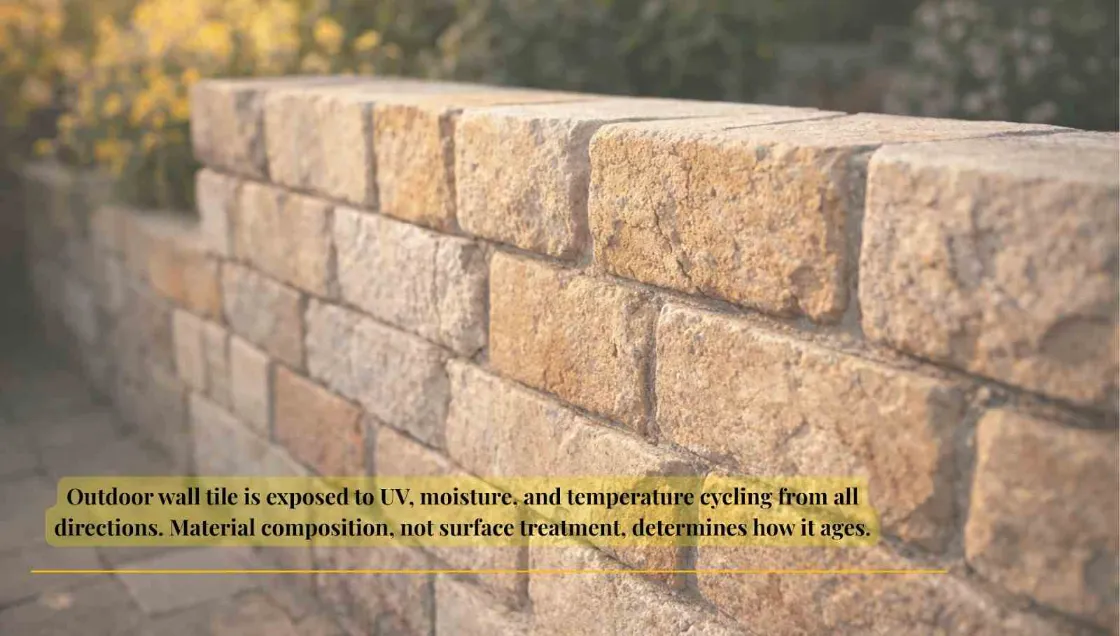
Outdoor wall tiles occupy an interesting position in this conversation. Unlike floor tiles, which have to contend with direct foot traffic and abrasion, wall tiles take the full force of sun, moisture, and temperature change without any of the structural protection that comes from being laid flat.
The glaze has nowhere to hide. The body of the tile is fully exposed. And if the material was not engineered for that exposure from the beginning, the degradation tends to show in exactly the places that matter most: color, texture, and the integrity of the finish.
Understanding what separates a tile that holds up from one that does not is worth the time before you specify or purchase.
The decisions made at this stage, material composition, surface finish type, installation substrate, and grout choice, determine whether your wall becomes a feature you maintain with pride or a surface you find yourself reconsidering.
What the outdoor environment actually does to wall tile

Outdoor wall tile faces a different set of stressors than most homeowners assume. UV radiation is the most persistent: it breaks down surface pigments over time, causing glazed finishes to fade and unglazed surfaces to shift in tone.
The rate of change depends on the colorant used in the glaze or the clay body.
Mineral-based pigments fired at high temperatures are significantly more stable under UV exposure than surface-applied colorants, which sit closer to the surface and have less protection.
Moisture is the second force.
Water does not just sit on a tile surface: it enters through micro-cracks in the glaze, expands if temperatures drop below freezing, and exerts pressure from within. This is the mechanism behind freeze-thaw damage.
A tile’s water absorption rate, expressed as a percentage of the tile’s weight, is the key indicator of how vulnerable it is to this cycle.
Tiles with a water absorption rate below 0.5% are classified as impervious and are engineered for exterior use in climates with genuine freeze-thaw exposure. Tiles above 3% absorption should only be used in covered or consistently warm outdoor conditions.
The third stressor is thermal expansion. As a wall surface heats during the day and cools at night, the tile, the adhesive, and the substrate all expand and contract at different rates. When these rates are mismatched, and when the installation does not allow adequate movement joints, the result is cracking, delamination, or grout failure. This is not a tile defect. It is an installation and specification failure that the right product selection, combined with correctly detailed expansion joints, prevents.
Choosing the right outdoor tile source matters too
If you’re in the process of planning an outdoor renovation, knowing what to look for when you choose outdoor tiles for patio and entertaining spaces will save you from some of the most common and costly specification errors.
A large part of that decision comes down to brand selection. Outdoor tile is not a category where visual appeal alone is enough.
The right supplier should be able to speak clearly about absorption rate, freeze-thaw suitability, sealing requirements, finish behaviour, and installation compatibility. Those details are what separate a beautiful sample from a surface that actually lasts outdoors.
For outdoor wall applications, it is worth looking for brands that understand the difference between a tile that simply looks artisanal and one that is genuinely made to weather well.
OUTERclé has become a notable reference point in this category because of its focus on handcrafted tile with the structural integrity and finish depth needed for demanding exterior environments. That combination, material character alongside genuine durability, is what makes a brand relevant at the specification stage rather than just the inspiration stage.
Material composition: where longevity is decided
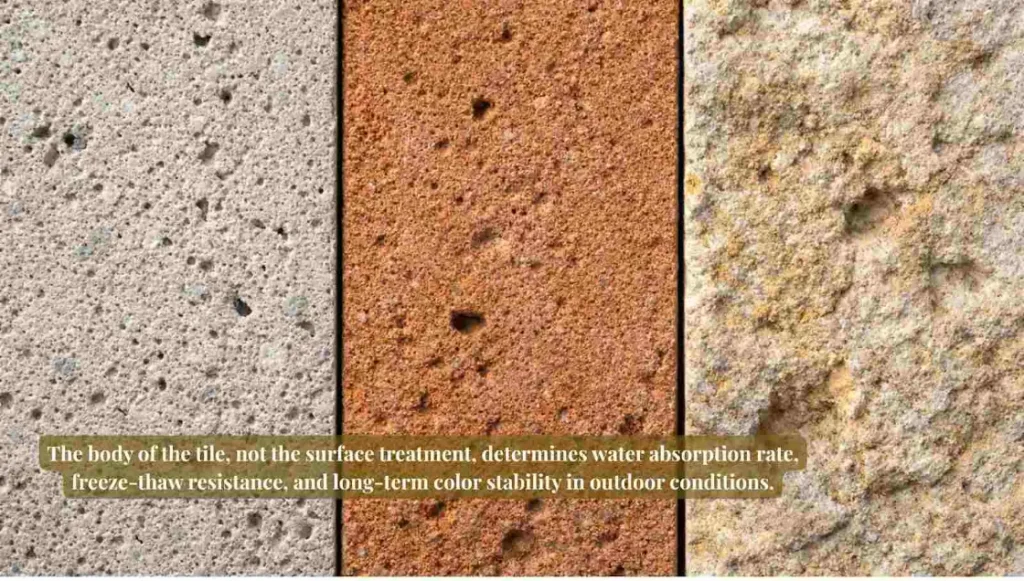
The body of the tile matters more than the surface finish for exterior durability. Many of these same durability issues are also familiar in exterior paint coatings, especially when it comes to UV fading and temperature-related surface stress.
There are three material categories worth understanding before making a selection.
Cement tiles
Cement tiles have been used on exterior walls and floors for over a century, and their continued presence in well-designed outdoor spaces is not nostalgic.
Cement tiles gain strength through a hydraulic pressing process using mineral pigments, cement, and marble powder.
The color runs through the full depth of the wear layer, which means surface wear does not reveal a different substrate underneath. They are porous by nature and require sealing before and after installation in outdoor applications, but when properly maintained, cement tiles develop a patina over time rather than degrading.
The surface gradually softens and integrates with the environment, which is precisely the quality that makes them desirable in spaces designed to age well.
Terracotta tiles
Terracotta tiles present a similar aging characteristic. The clay body is fired at lower temperatures than porcelain, giving it a warmer, more organic surface and a slightly higher absorption rate.
For outdoor wall applications in mild climates, properly sealed terracotta performs well and develops a depth of color over time that fired glazes cannot replicate.
In climates with significant freeze-thaw exposure, terracotta requires more careful specification, including a lower-absorption variety and a high-quality impregnating sealer applied annually.
Stone and stone-composite tiles
Stone and composite tiles including terrazzo, bring exceptional density and low absorption, but color stability depends on the specific stone type.
Darker stones, particularly those with high iron content, can show surface oxidation over time.
Lighter limestones and marbles are susceptible to acid etching in environments with acid rain or proximity to chlorinated water.
Specifying a honed rather than polished finish on stone used outdoors improves both slip resistance and resilience to surface marking over time.
Glaze, finish, and the surface behaviour you can predict
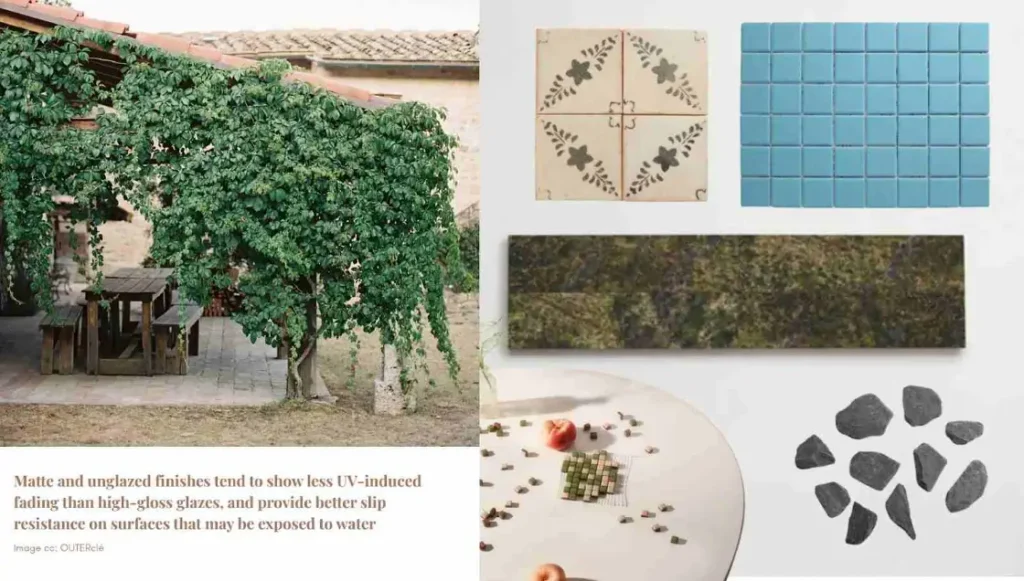
Glaze chemistry determines how a tile’s surface behaves under outdoor stress. High-gloss glazes have a smooth, sealed surface that is easy to clean and initially vibrant in color, but they are also more susceptible to UV-induced yellowing or fading over time, particularly in darker shades. Matte and satin glazes absorb and scatter light differently, which tends to make color shifts less perceptible as the material ages.
Unglazed tiles
Unglazed tiles, where color comes from the clay body itself or from through-body pigmentation, are often the more honest choice for exterior walls. There is no glaze layer to crack, fade, or delaminate. The surface texture that develops with weathering is not damage: it is patina.
This is the quality that distinguishes handcrafted exterior surfaces from mass-produced alternatives.
A tile where the color is fired into the body at over 1,000 degrees Celsius is not going to behave the same way as a surface-treated tile when it has absorbed a few seasons of sun and rain.
One practical indicator that is easy to overlook: texture and slip resistance matter on wall tiles too, not for foot traffic, but because a heavily textured surface will trap more moisture and organic matter, requiring more maintenance.
The right balance for most exterior wall applications is a surface with enough texture to show material character and avoid the uniform flatness of glazed porcelain, but smooth enough to clean with a hose and a brush once or twice per year.
Installation variables that determine long-term performance
The tile itself is only part of the equation. The most common cause of outdoor wall tile failure is not a deficient product: it is an installation that was not designed for exterior exposure.
1. Substrate preparation is the starting point.
The wall surface must be structurally sound, free of flex, and waterproofed before any tile is applied. In exterior applications, an uncoupling or decoupling membrane between the substrate and the tile layer provides the differential movement tolerance that prevents cracking when temperatures shift. Skipping this layer to save cost is a reliable route to a tile replacement conversation within three to five years.
2. Adhesive selection matters significantly.
Standard interior tile adhesives are not formulated for exterior thermal cycling. A flexible, polymer-modified exterior-grade adhesive, rated for the temperature range relevant to your climate, is not optional. In hot climates like South Florida, where tiles heat rapidly in direct sun and cool quickly in afternoon rain, the adhesive’s flexibility rating directly affects how well the installation tolerates daily thermal stress.
3. Movement joints
sometimes called expansion joints, are the most consistently under-specified element in exterior tile installation. Building codes and industry guidelines from organizations such as the Tile Council of North America (TCNA) specify joint placement at regular intervals across a tiled surface and at all changes in plane, structural joints, and transitions to adjacent materials.
When movement joints are omitted or undersized, the thermal expansion of the tile assembly has nowhere to go. The grout cracks, then the tile, then the adhesive bond. Correct joint placement, filled with a flexible sealant rather than rigid grout, is the detail that makes the difference between a wall that looks right in year ten and one that needs remediation in year three.
What to look for when specifying outdoor wall tile
For homeowners and design professionals approaching an outdoor wall tile specification, a practical checklist makes the process more reliable. Most product data sheets will carry some or all of this information; for handcrafted tiles, it is worth contacting the supplier directly if it is not published.
- Water absorption rate: Look for below 0.5% for climates with freeze-thaw exposure; below 3% for covered or warm-climate exterior applications.
- Freeze-thaw rating: Confirmed freeze-thaw resistance is a specific test result, not a general claim. Ask for it if your climate requires it.
- UV color stability: Mineral-based pigments and through-body color hold better than surface-applied colorants under prolonged sun exposure.
- Sealing requirements: Cement, terracotta, and natural stone tiles used outdoors require sealing before grouting and periodically thereafter. Understand the maintenance commitment before specifying.
- Slip resistance (DCOF): Even on walls, consider whether the surface will be exposed to water from rain or irrigation. A textured or matte finish generally performs better in wet conditions than a high-gloss glaze.
- Movement joint specification: Confirm that your installer has referenced TCNA guidelines for expansion joint placement in exterior applications.
The difference between a surface that ages and one that deteriorates
The best outdoor wall tiles share one characteristic: they were designed with outdoor exposure as the brief, not as an afterthought.
That means material composition suited to the thermal and moisture conditions of your specific climate, a surface finish chosen for what it will look like in year five rather than just year one, and an installation approach that accounts for movement, waterproofing, and joint placement from the outset.
A well-specified and properly installed outdoor wall tile does not fight the environment. It develops alongside it, building the kind of surface character that makes a patio or garden wall feel like it belongs where it is rather than having been placed there.
That is the difference between a surface that ages and one that deteriorates.
And it is a distinction that is entirely within reach when the specification decisions are made with the full picture in mind.